

Toward Truly Personalized Medicine
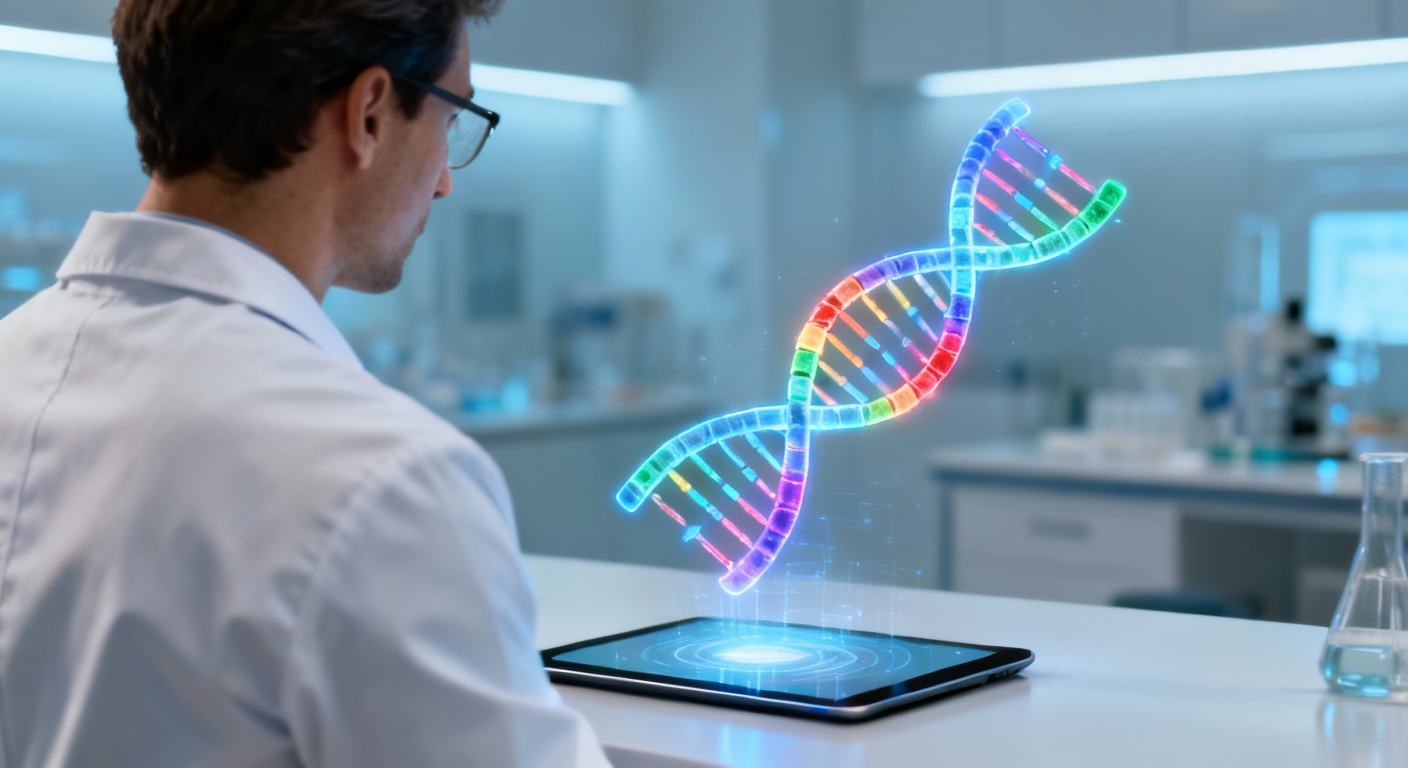
Imagine a future where we could correct genetic defects as easily as correcting a typo. That’s exactly the horizon Google DeepMind is opening up with its brand-new artificial intelligence tool: AlphaGenome. The idea? To analyze long strands of DNA—up to a million base pairs—to understand how tiny mutations influence our biology.
Today, your genome acts as your cells’ instruction manual. But tiny variations in this code can make you more susceptible to certain diseases or alter the way your body reacts to stress, cigarette smoke, or viruses. Until now, it’s been difficult to decipher it all. AlphaGenome is a game-changer: this program allows scientists to see precisely how these changes trigger diseases. Better yet, this opens the door to the design of synthetic DNA capable of activating or deactivating genes in specific areas of the body. This is something that current gene therapy cannot yet do, and it marks the beginning of a new era for personalized medicine.
The Secret of the 98%: Unlocking “Junk” DNA

For a long time, it was believed that a large portion of our DNA served no purpose. Basically, the genome consists of about 2% genes that code for proteins. And the rest? It was called “junk” DNA. Except that we now know this isn’t true: this vast majority of genetic material (98% of the total!) plays a crucial role in regulating genes, boosting or reducing their activity, and influencing the health of our cells. This is where Google DeepMind makes a major breakthrough: unlike previous programs, AlphaGenome is capable of interpreting the impact of this “junk” DNA.
Ziga Avsec, who leads the genomics initiative at DeepMind, explains that this tool could be used to create entirely new DNA. “AlphaGenome could be used to generate short segments of non-coding DNA that do not exist in nature,” he says. What’s the point? To create a “synthetic switch.” Ziga Avsec elaborates: “In the context of gene therapy, you would include this synthetic code […] to ensure that the therapy activates only in the specific target tissue—such as the retina or the liver—while remaining silent in the rest of the body. ” This surgical precision would make it possible—in addition to manufacturing synthetic DNA—to identify mutations that cause diseases or, conversely, beneficial changes.
A giant leap validated by experts

To achieve this, the model was trained on human and mouse genomes, learning to understand how different sequences drive our biological processes. And the scientific community is abuzz. Dr. Robert Goldstone, head of genomics at the Francis Crick Institute in London, makes no secret of his enthusiasm: “DeepMind’s AlphaGenome represents a major milestone in the field of genomic AI.” For him, this ability to analyze non-coding DNA with such high resolution is a breakthrough that moves the technology from theory to practical application. “One of the most remarkable demonstrations is its ability to predict gene expression based solely on the DNA sequence,” he adds.
Of course, there is still a long way to go. This study, published in the prestigious journal Nature, also inspires cautious optimism. Professor Rivka Isaacson, a molecular biophysicist at King’s College London, sees this work as an exciting step toward shedding light on the “dark genome.” She qualifies this, however: “We still have a long way to go to understand the long sequences of our DNA that do not directly code for the protein machinery whose constant hum keeps us healthy.” ” She doubts that we will ever be able to unravel all the possibilities and complex feedback mechanisms, but acknowledges that AlphaGenome offers scientists “vast, previously unaccessed datasets to sift through and search for clues.” Experts also hope that this model will soon help interpret the DNA of plants, animals, and microbes that have not yet been extensively studied.
Source: telegraph.co.uk
Created by humans, assisted by AI.
Customized DNA could revolutionize disease treatments


