

The Paradox of the Tightrope-Walking Snake
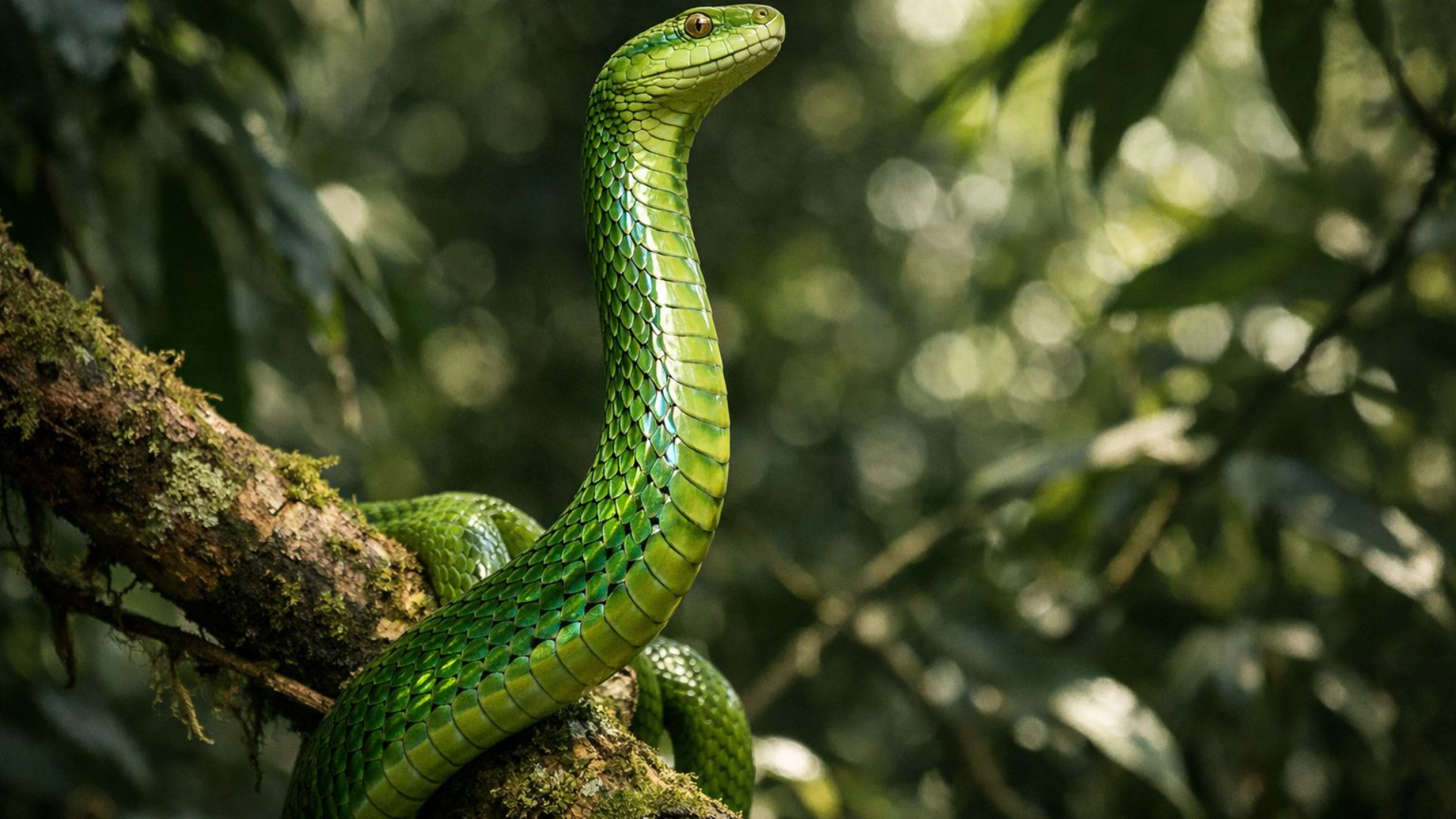
At first glance, a snake doesn’t seem built to stand upright. Devoid of legs and endowed with a body that’s flexible in all directions, it lacks the rigid spine that could serve as a support. Yet observation contradicts this logic: some snakes are capable of rising almost vertically and maintaining this unlikely posture.
An investigation at the crossroads of science
To unravel this mystery, a team of researchers set out to investigate the question. Their work, which combines biology, mathematics, and mechanical modeling, reveals that the solution is not simply a display of brute force. Rather, it is a subtle blend of physics, muscular control, and the snake’s keen awareness of its own body shape.
This research was conducted by a team led by L. Mahadevan of Harvard University, whose group specializes in studying the physics behind biological movements. "For some, this may be the stuff of nightmares, but we have now analyzed, both mathematically and physically, the hidden physics and control strategies that allow snakes to defy gravity," explains Professor Mahadevan.
The secret lies at the foundation of the movement
On the contrary, control is exercised primarily in a small section at the base, right at the point where the body leaves its perch. The muscles in this short region—which the researchers describe as a “boundary layer”—contract intensely. Above this zone, the rest of the body remains almost perfectly straight. This strategy is effective because, when the body is vertical, gravity exerts very little bending force. By concentrating the effort at the base, the snake minimizes the energy required to remain upright.
Sensing Its Body to Better Control It
The researchers also examined how snakes coordinate their muscles. A key factor is proprioception—that is, the animal’s ability to sense the position and shape of its own body. To explore this mechanism, the team created a mathematical model that treats the snake as an “active elastic filament”: a flexible structure capable of detecting its own shape and responding to it with muscular forces.
When Snakes Inspire Engineers
Understanding how snakes focus control on a single part of their body could help engineers design more stable and energy-efficient machines. “By concentrating control where it matters most, engineers could learn to build machines that are both efficient and resilient,” says Ludwig Hoffmann, the study’s lead author and a postdoctoral researcher in applied mathematics. Once again, nature demonstrates that it solves complex physical problems with surprisingly simple strategies.
Source: earth.com
How Snakes Defy Gravity: The Secret to Their Balance Finally Revealed


