Skip to content

The Mystery of the Relentless Hammering

The woodpecker is an extreme athlete. Every day, it strikes tree trunks thousands of times, driving its beak into solid wood with remarkable force and speed. For years, scientists believed they had the answer to this mystery: the woodpecker’s skull must function like a protective helmet—a sophisticated shock absorber that absorbs every impact.

However, a new study challenges this long-held belief. The real solution may not lie in cushioning the impacts, but in a much more subtle management of forces. The woodpecker’s anatomy is actually designed to control the way these shock waves travel through its head.

Rather than absorbing the force, the woodpecker’s skull channels it. It keeps the beak, jaw, and skull in such perfect alignment that the force of the strikes travels along stable paths, preventing any potentially devastating twisting of the head. This structural design allows it to hammer away relentlessly without damaging its skull or joints.

A skull designed for stability, not for absorption
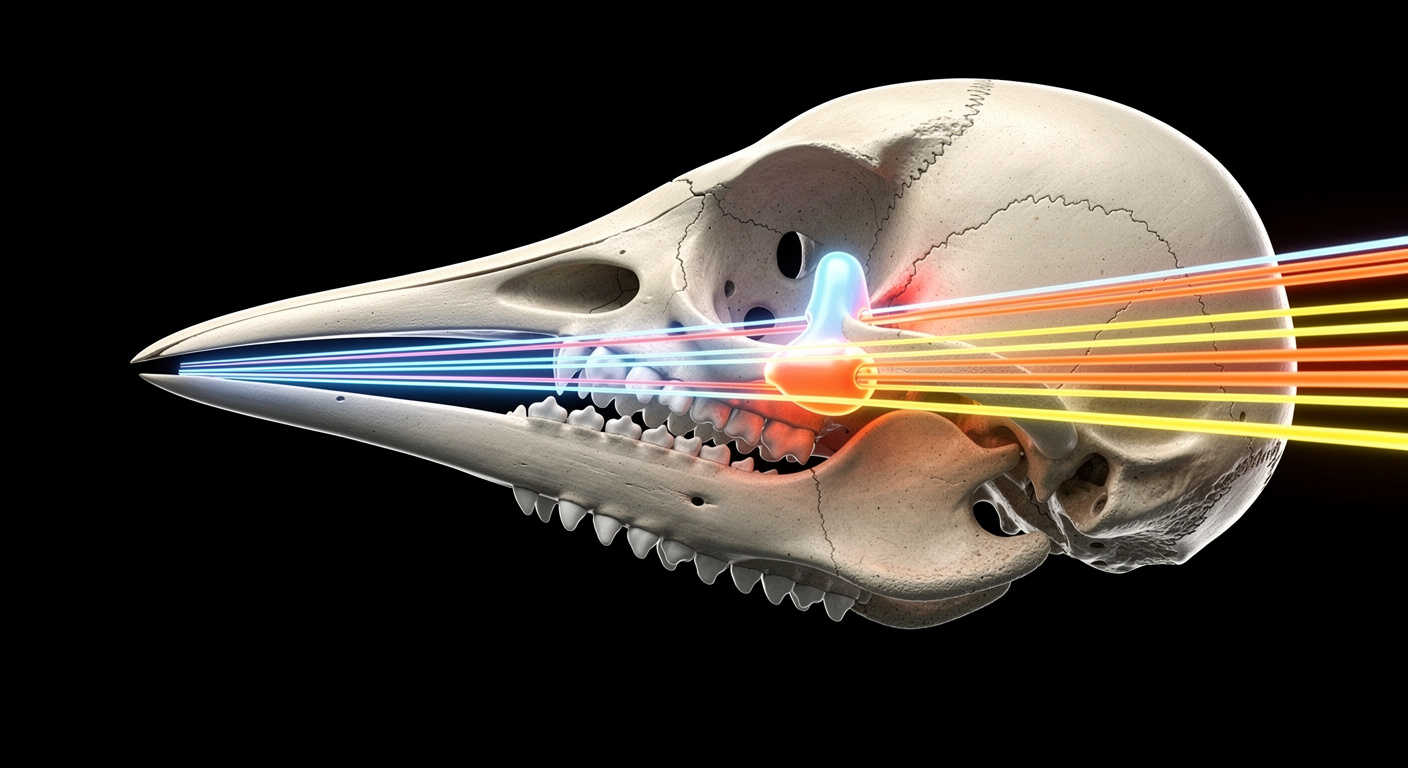
Every peck delivered by a woodpecker sends a wave of force directly through its skull. Even the slightest rotational movement at the moment of impact could destabilize the delicate joints connecting the beak, jaw, and skull. How does the bird avoid this danger?

To understand this, Sebastián Lyons of the National University of La Plata conducted a comparative analysis of the skull structures of numerous bird species. His team discovered that in woodpeckers, the alignment between the beak, jaw, and skull is exceptionally rigid. This arrangement forces the energy from each strike to travel in a straight line through the head, preventing the buildup of twisting motions.

The secret lies in the jaw joint. In birds, the lower jaw connects to the skull via a movable bone called the quadrate bone. In woodpeckers, this hinge is arranged in a much more compact and flattened manner. Since the impact occurs closer to these joints, there is less leverage. This reduces torque—the twisting force that can damage structures during repeated impacts. As Sebastián Lyons summarizes: “The woodpecker’s skull is not designed to absorb impacts.” Instead, its shape helps keep the entire system aligned so that powerful forces remain stable rather than becoming rotational.

An exception to the rules of avian evolution
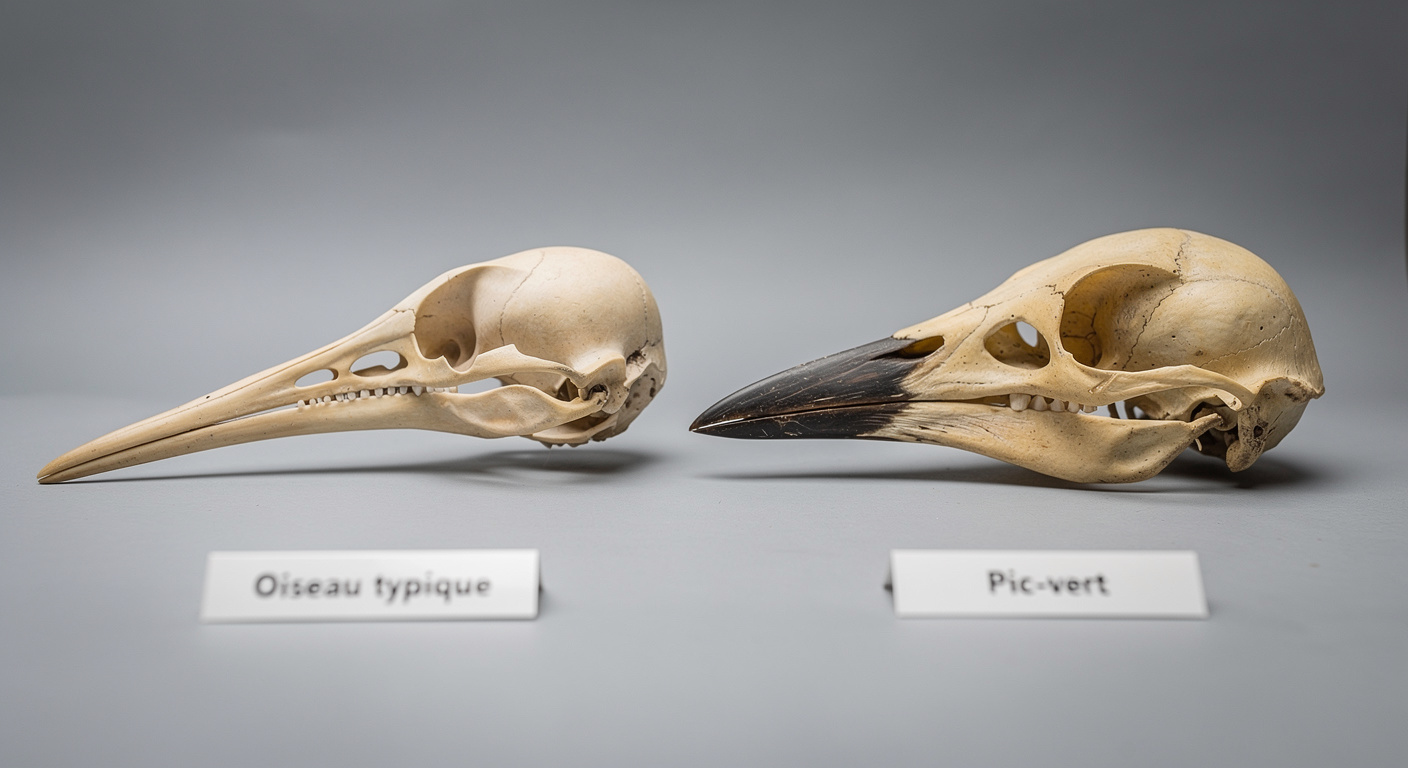
Researchers have also uncovered a fascinating peculiarity: woodpeckers deviate from a growth pattern common to many other birds. Generally, as most birds grow, their faces elongate forward, while their skulls become proportionally longer and narrower. Biologists call this phenomenon allometry, a principle whereby body parts change size together as the animal grows.

This elongation of the face increases the distance between the point of impact and the skull joints, which could amplify rotational forces. This is a problem that woodpeckers have managed to circumvent. Even among the largest species, they retain a relatively compact face and a more rounded skull.

This unique arrangement allows them to have larger heads without creating long lever arms that would increase torsional stresses during hammering. Brain size also appears to play a role. Rather than stretching the face to make room for a larger brain, woodpeckers reorganize the proportions within the skull itself. A rounder skull can thus accommodate more brain tissue while keeping the impact-bearing portion of the skull compact. This combination suggests a fascinating co-evolution between the brain and the mechanics of the impact, although the study did not directly test this behavior.

Pecking: A Whole-Body Effort

While the skull is a key component, it is only one part of the complex system that allows woodpeckers to drill safely. These birds can strike wood thousands of times a day. Older estimates even suggest the impressive figure of 12,000 strikes per day.

Recent research shows that each strike engages muscles throughout the body: the head, neck, hips, tail, and abdomen. Woodpeckers also synchronize their breathing with their effort, exhaling with each strike. This action stiffens the body and helps channel energy directly into the tree. Together, these movements create a stable body framework that supports the skull during repeated impacts.

The study also revealed that these stabilizing characteristics vary from one species to another. Woodpeckers specialized in powerful drilling have more pronounced reinforcing surfaces where the jaw joint meets the rest of the skull. Conversely, smaller species or those that strike less forcefully exhibit these traits in a less pronounced form. This variation suggests that skull design has evolved gradually, adapting to the different lifestyles and behaviors of each species.

New Lessons for Engineering and Science

Ultimately, the secret to the woodpecker’s survival may not lie in shock absorption. Rather, their skulls appear to be designed to guide forces along stable lines. Previous research, conducted in 2022, had already shown that woodpeckers’ heads absorbed surprisingly little shock and remained mechanically rigid during hammering. The new study, published in the Journal of Anatomy, adds another piece to the puzzle by explaining how the proportions of the skull and the geometry of the joints make this rigidity possible.

This discovery could have implications far beyond ornithology. Engineers often study biological materials to design impact-resistant structures, but this research suggests that the geometry and direction of forces may be just as crucial as the strength of the material itself. “Our results show that skull geometry is a key factor in their remarkable performance when faced with impacts,” concludes Sebastián Lyons.

However, many questions remain unanswered. Skull shape does not explain everything. In living birds, muscles, posture, breathing, and precise synchronization are essential. The new research focused on bones and evolutionary patterns, without testing how soft tissues distribute forces during actual strikes. Future studies could therefore examine the interaction between skull shape, neck movement, and brain dynamics across different species, depending on whether they peck frequently, drill deeply, or strike forcefully only rarely.

Source: earth.com

The woodpecker’s secret: its head isn’t a shock absorber, but a force guide

facebook icon twitter icon linkedin icon
Copied!

Commentaires

0 0 votes
Article Rating
Subscribe
Notify of
guest
0 Comments
Newest
Oldest Most Voted
Inline Feedbacks
View all comments
More Content