

Two rooms, two atmospheres
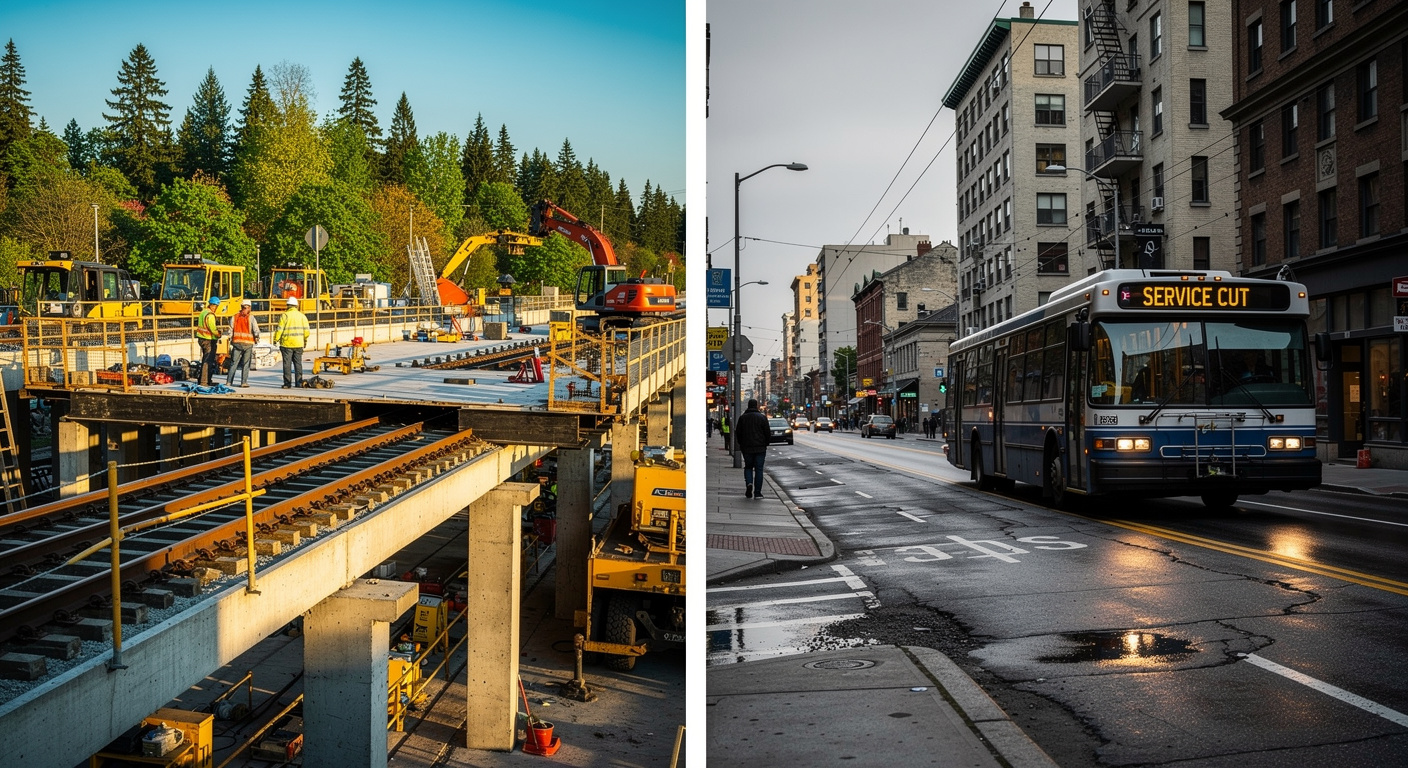
Do you feel like public transit projects are stalling here? Take a look at what’s happening on the other side of the country—it might make you cringe. While Quebec is making budget cuts, the Vancouver metropolitan area has just hit the jackpot.
The figure is mind-boggling: 1.5 billion dollars. That’s the amount Vancouver will receive from the federal government over 10 years through the new Canada Public Transit Fund (CPTF). In practical terms, starting next spring and continuing through 2036, the western metropolis will receive an average of 150 million per year. Fresh, predictable money, ready to be invested.
And here? It’s a world turned upside down. Municipalities are up in arms over the $200 million in cuts imposed by the CAQ government on the Public Transit Development Assistance Program (PADTC). The contrast is striking.
“A Problem of Vision”

For Marie-Soleil Gagné, executive director of Accès transports viables, the verdict is clear: the Legault government “hasn’t done its homework.” In her view, this reflects a severe lack of vision. Ultimately, who will be left to pick up the pieces? The public, she warns.
She politely suggests looking westward for inspiration. Why? Because in Vancouver, municipal, provincial, and federal governments have been pulling in the same direction for years. They’ve woven a true “mobility network” where trains, ferries, and buses complement one another. In fact, two SkyTrain extensions are currently under construction there: we’re talking about 20 kilometers of additional track and 14 new stations.
Meanwhile, in the National Assembly, tempers are flaring. Monsef Derraji, the official opposition’s House leader, is seething with impatience. “Sign this agreement!” shouts the Liberal MNA for Nelligan. As far as he’s concerned, the money is on the table, ready to be used. He finds it ironic—not to say infuriating—to see another province pocket exactly the amount that the Legault government has just cut.
His conclusion? We have a “weak” government when it comes to dealing with the federal government, one that “doesn’t believe in public transit.” He is urging Quebec to act, especially since Ottawa has already slashed 5 billion from the FTCC’s overall budget.
Tense Negotiations and Billions at Stake

But then, where is Quebec’s money? For now, nowhere. In the absence of a signed agreement on the framework for transfers, the province has come up empty-handed.
Discussions are continuing, however. Quebec’s Minister of Transport, Jonatan Julien, is negotiating with his federal counterpart for Housing and Infrastructure, Gregor Robertson. They met in Montreal before the holidays; it was a visibly cordial meeting that yielded some progress. Jonatan Julien’s office also assures us that even though the minister will not be seeking re-election in the upcoming elections, his determination to see these projects through remains undiminished.
The crux of the problem is a classic one: Quebec wants the money with no strings attached, while Ottawa wants to keep an eye on its funds. And let’s face it, trust is in short supply. The CAQ’s numerous about-faces—think of the Québec City tramway or the third link—have left the federal government wary.
Speaking of the tramway, the numbers are on the table: Ottawa is currently contributing 1.44 billion toward a total cost of 7.6 billion. Québec would like to see the federal government double its contribution to cover 40% of the project. That said, regardless of the outcome of this standoff, the involvement of the Caisse de dépôt et placement du Québec (CDPQ) as the project manager should help finalize the financing package.
Source: ici.radio-canada.ca
Created by humans, assisted by AI.
Transportation: While Quebec Cuts Spending, Vancouver Rakes in 1.5 Billion
This content was created with the help of AI.


