Skip to content

A Major Breakthrough for Green Hydrogen at KIST

Green hydrogen production technology, which uses renewable energy to generate eco-friendly hydrogen with zero carbon emissions, is gradually emerging as a key solution in the fight against global warming. This process relies on electrolysis, a method that separates hydrogen and oxygen by applying electrical energy to water. To be viable, this technique requires catalysts that are inexpensive, highly efficient, and effective.

In this competitive landscape, a research team led by Dr. Na Jongbeom and Dr. Kim Jong Min at the Extreme Materials Research Center of the Korea Institute of Science and Technology (KIST) has developed a next-generation water electrolysis catalyst technology. Their work, which marks a significant breakthrough in the field, was published in the scientific journal Advanced Energy Materials.

This innovation stands out for its integration of a single-atom “all-in-one” catalyst—precisely controlled down to the atomic level—combined with binder-free electrode technology. The researchers’ stated goal is to address the cost and performance challenges that continue to hinder the widespread industrial deployment of green hydrogen.

The Costly Limitations of Current Electrolysis Systems
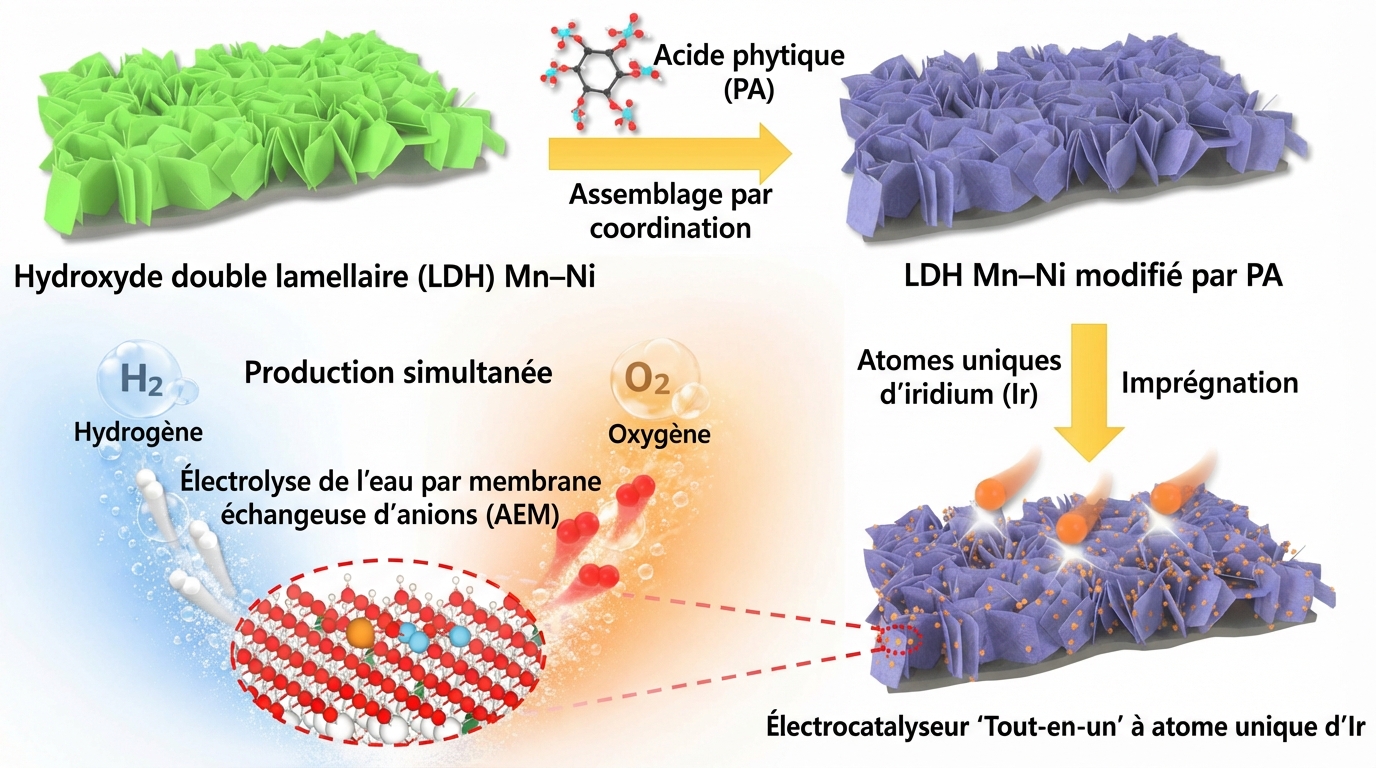
Until now, existing electrolysis systems have faced significant technical and economic limitations. They required the use of different catalysts and electrode structures to manage two distinct reactions: the hydrogen evolution reaction (HER) and the oxygen evolution reaction (OER). This duality forced manufacturers to use large quantities of expensive precious metals to ensure the system’s operation.

In addition to the cost of materials, the very structure of the electrodes posed a problem. Conventional systems use a binder to attach the catalyst to the electrode. However, this additional component leads to several technical complications, including reduced electrical conductivity.

Furthermore, the use of binders compromises the device’s durability. During long-term operations, catalyst detachment is frequently observed, which undermines the overall stability of production. The key feature of the new technology developed by KIST lies precisely in its ability to stably and simultaneously carry out hydrogen and oxygen evolution reactions on a single electrode, thereby eliminating these structural constraints.

The Technical Innovation: The Single-Atom Strategy

To overcome these obstacles, KIST researchers employed a technology that enables precision control at the atomic level. Their method involves uniformly dispersing iridium (Ir) atoms on the surface of a support composed of a double-layered hydroxide (LDH) based on manganese (Mn) and nickel (Ni), incorporating phytic acid into it. This strategy replaces the conventional use of bulk iridium, a precious metal.

The scientific team’s approach aims to maximize the number of active sites required for water-splitting reactions while using a minimal amount of iridium. To illustrate this concept of surface optimization, the process is analogous to spreading fine grains of sand evenly over a large surface, rather than relying on a single large rock.

The single iridium atom plays a pivotal role in this system. It acts as a direct active site for the hydrogen evolution reaction due to its strong interaction with the support. Simultaneously, it enhances the catalytic performance of the nickel-based active site, where the oxygen evolution reaction takes place. As a result, this single-atom catalyst has achieved bifunctional catalytic characteristics, exhibiting reactivity suited for both reactions.

A binder-free structure for enhanced performance
Beyond the chemistry of the catalyst, the research team innovated in the very fabrication of the electrode. They applied a method involving the direct growth of the catalyst on the electrode surface. This technique yields an electrode structure that requires no separate binder, thereby resolving the conductivity issues mentioned earlier.

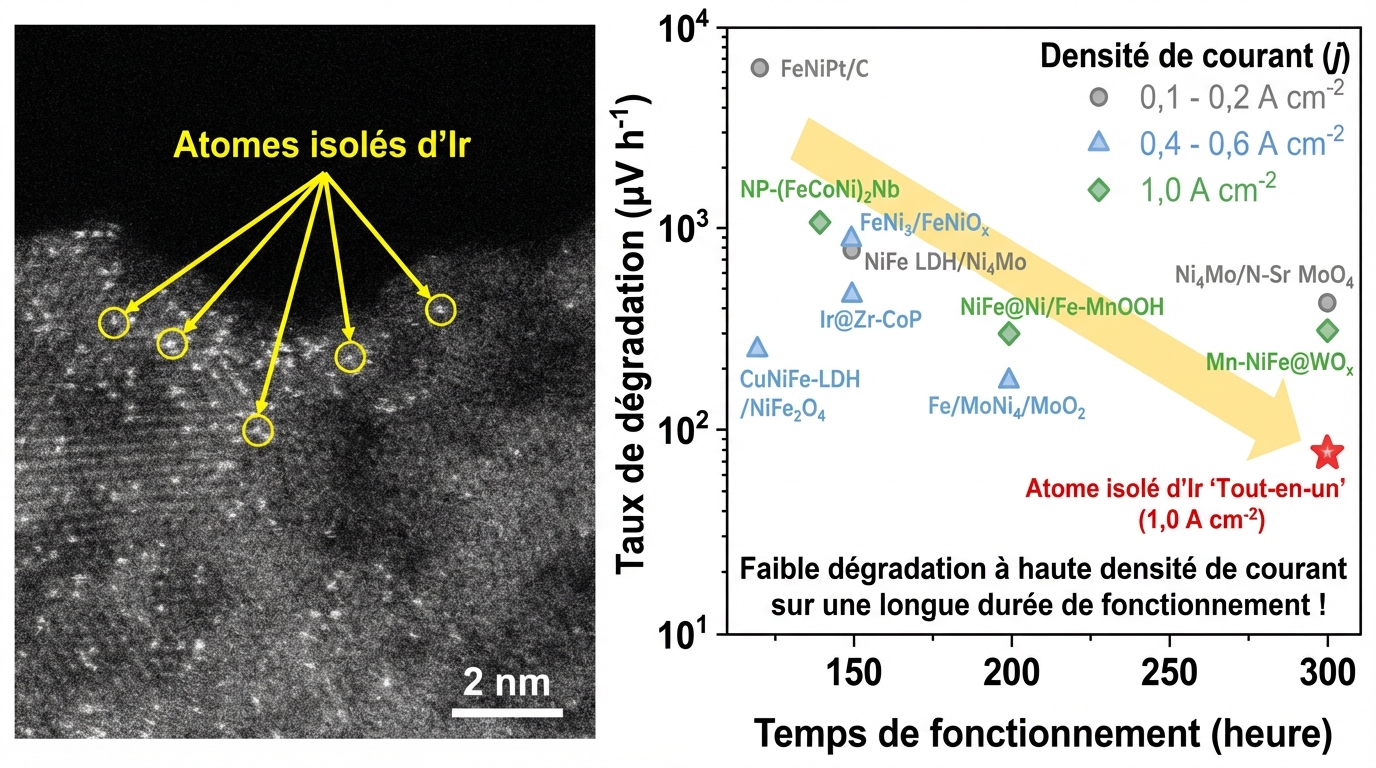
This structural approach has significantly improved the system’s electrical conductivity. It has also ensured excellent durability, even during long-term operation, by eliminating the risk of detachment associated with traditional chemical binders. The overall robustness of the system is thereby enhanced, offering a more reliable solution for manufacturers.

The measured performance is significant. This technology reduces the use of precious metals to less than 1.5% compared to existing precious-metal catalysts, while achieving exceptional performance for both hydrogen and oxygen evolution reactions.

Toward Accelerated Commercialization of Hydrogen

The system’s stability has been rigorously tested. The device demonstrates high stability with minimal performance degradation, even after more than 300 hours of continuous operation in an anion-exchange membrane (AEM) water electrolysis system. These results confirm the solution’s long-term technical viability.

This research result demonstrates the technical feasibility of simultaneously improving the economic viability and sustainability of electrolysis systems. By minimizing the use of precious metals and simplifying electrode structures, this technology is expected to contribute significantly to the commercialization of green hydrogen production and to reducing hydrogen production costs in the future.

Dr. Na Jongbeom of KIST emphasized the importance of this discovery: “This work is highly significant because it resolves the two essential reactions for hydrogen production using a single catalyst while reducing the consumption of precious metals. This technology will accelerate the commercialization of water electrolysis devices and provide substantial support for the expansion of hydrogen energy.”

Source: phys.org

A single "all-in-one" atom could power both sides of water splitting

facebook icon twitter icon linkedin icon
Copied!

Commentaires

0 0 votes
Article Rating
Subscribe
Notify of
guest
0 Comments
Newest
Oldest Most Voted
Inline Feedbacks
View all comments
More Content