Skip to content

The Limitations of Current Protections Against Shock Waves
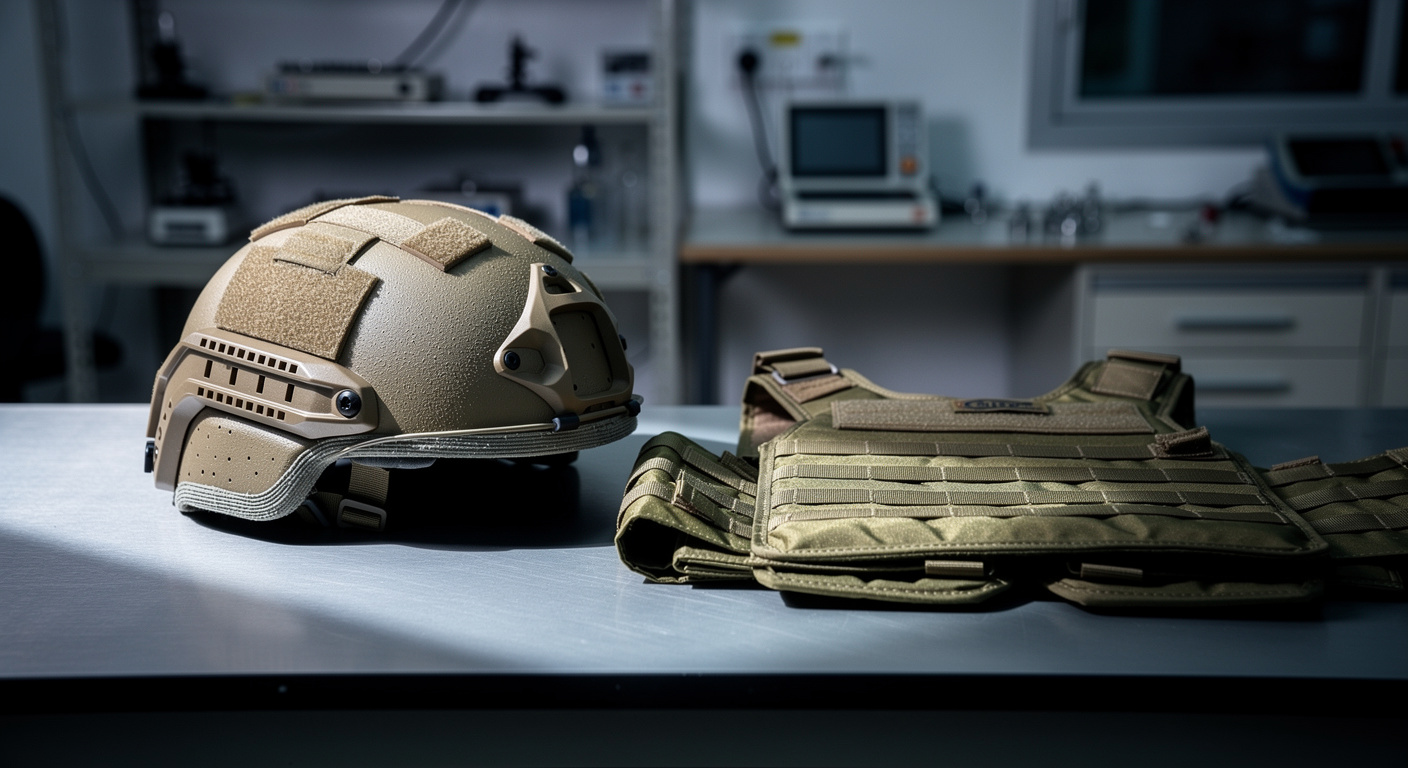
Modern armor systems, though sophisticated, do not sufficiently protect humans from blast-induced neurotrauma. This damage, which particularly affects the brain and eyes, remains a major concern for the safety of people exposed to explosions.

To improve these protective systems, scientists are now turning to nature—and more specifically to an unexpected creature: a tiny shrimp. This crustacean possesses the unique ability to protect itself from the shock waves it generates to stun its prey and rivals.

Pistol shrimp produce powerful shock waves by snapping their claws together. While their targets are stunned by the impact, these small crustaceans themselves suffer no similar trauma. Previous research had already revealed that they are protected by an orbital cap, an extension of their carapace (the hard upper shell covering the main body), which dampens the shock waves to prevent damage to neural tissue.

A new study unravels the anatomy of the pistol shrimp

In a recent study published in 2026 in the Journal of the Royal Society Interface (DOI: 10.1098/rsif.2025.0769), a team of researchers from the University of South Carolina and the University of Tulsa examined the exact functioning of this protective structure.

The study relies in particular on a micro-computed tomography (MicroCT) reconstruction of the head of the species A. heterochaelis. This high-resolution imaging allows researchers to visualize, in a virtual sagittal section, the relative positions of the various organs. Visible in the image are the orbital hood (shown in red in the models), the carapace (in blue), the eyes (in yellow), and the brain (in green).

A crucial anatomical detail has been revealed: the anterior opening of the orbital hood (indicated by a white arrow in the research documents) leads to a water-filled chamber located between the hood and the eyes. The scale used for these observations is on the order of one millimeter, highlighting the intricacy of this biological architecture.

Mechanical tests reveal a unique structure

To understand the physical properties of this natural armor, the researchers conducted a series of mechanical tests. They pulled and stretched both the orbital hood and the rest of the carapace to compare their stiffness and energy-absorption capacity.

In addition to these physical tests, the team used transmission electron microscopy (TEM). This technology allowed them to observe the inner layers of the shell with extreme precision. The results of these tests indicate that the orbital cap is significantly different from the rest of the shell.

The data show that it is only half as rigid as the rest of the shell, but can absorb twice as much energy. The explanation lies in its internal structure: the cap contains twice as many tiny internal layers, called lamellae. It is this density of lamellae that makes the structure flexible enough to dampen a shock wave at the moment of impact.

Simulations confirm optimized protection

After collecting this biological data, the researchers incorporated it into a computer model to simulate a shock wave striking a shrimp’s head. These numerical simulations made it possible to precisely quantify the effectiveness of the natural mechanism.

The results are significant: the cap reduced the deformation experienced by the shrimp’s brain and eyes by nearly 28%, and the stress by 22%. The team also discovered that this structure appears to be perfectly optimized for its specific function.

In fact, attempts to modify the parameters in the computer simulation yielded counterintuitive results. Increasing the stiffness or thickness of the material paradoxically reduced its protective capacity, proving that the natural balance achieved by the crustacean is ideal for dissipating energy.

Toward a New Generation of Helmets and Armor
The findings of this study suggest that the shrimp benefits from a complex multilayered protection system. As the researchers note in their article: “We propose that the orbital caps dampen shock waves through a series of mechanisms that are not mutually exclusive, but rather work to optimize energy absorption on a microscopic scale and energy redirection on a more macroscopic level.”

This discovery opens up concrete possibilities for protective engineering. Understanding the structure of the pistol shrimp’s cap could be a decisive first step in designing more effective helmets and body armor.

The ultimate goal is to develop equipment capable of better protecting humans and minimizing blast-induced brain injuries, drawing direct inspiration from solutions proven by biological evolution.

Source: phys.org

Created by humans, assisted by AI.

A tiny shrimp may hold the secret to the armor of the future

This content was created with the help of AI.

facebook icon twitter icon linkedin icon
Copied!

Commentaires

0 0 votes
Article Rating
Subscribe
Notify of
guest
0 Comments
Newest
Oldest Most Voted
Inline Feedbacks
View all comments
More Content