

Rewriting History: Life Goes On Amid the Ruins
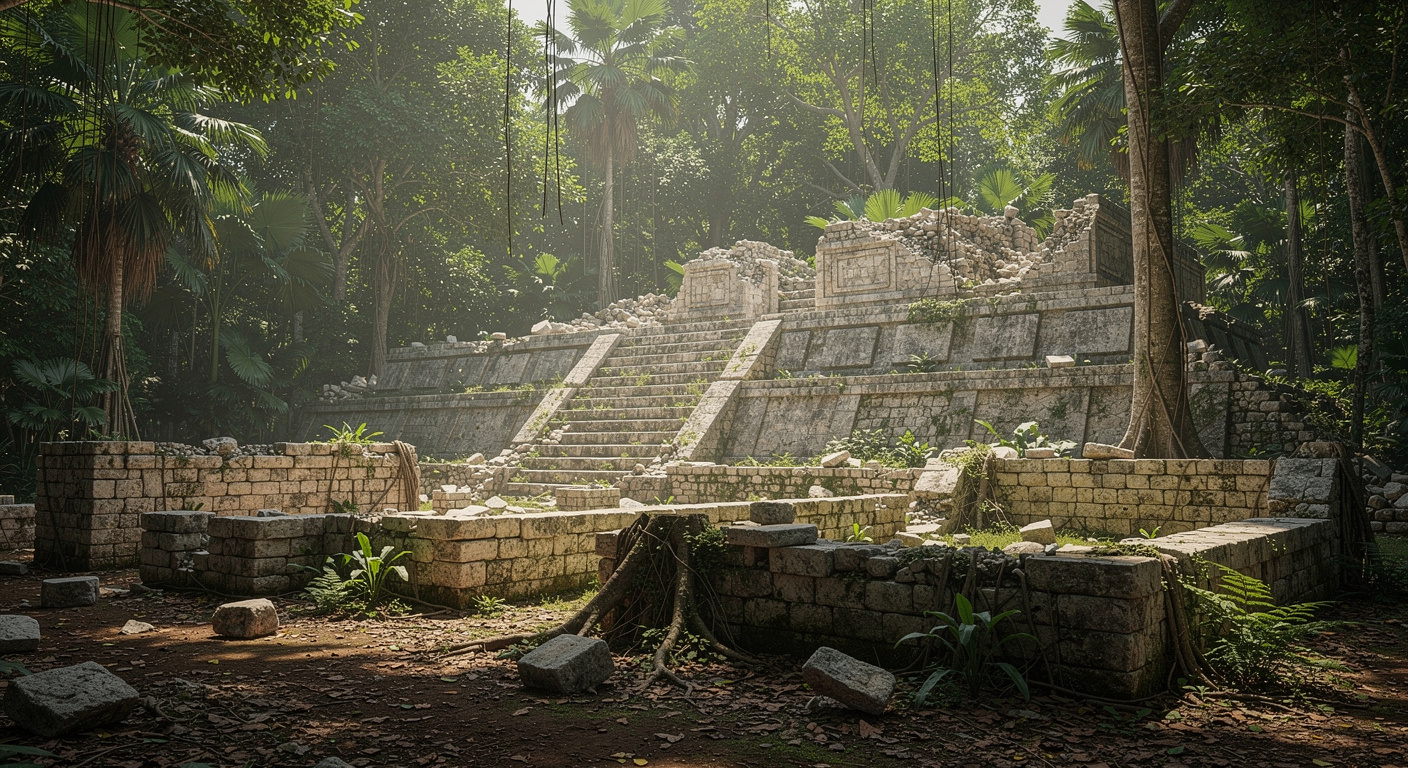
It was within the monumental center of Aké, located on Mexico’s Yucatán Peninsula, that these clues emerged. Low stone platforms mark the sites where modest homes once stood amid collapsed temples and plazas once reserved for kings. These remains bear witness to human persistence where history saw only emptiness.
Recognizing this continuity within the ruins themselves challenges the persistent image of total abandonment. It also raises broader questions about how the crisis unfolded beyond the walls of Aké, suggesting an unsuspected capacity to adapt in the face of climatic and political upheavals.
The Occupation of the Sacred Heart: Archaeological Evidence at Aké
Archaeologist Dr. Roberto Rosado-Ramirez, of Mexico’s National Institute of Anthropology and History (INAH), conducted meticulous documentation by mapping 96 of these structures within the ancient ceremonial center. His work has confirmed the presence of a sustainable community that persisted after the fall of royal power.
Walls and Mud: The Physical Scars of the Crisis
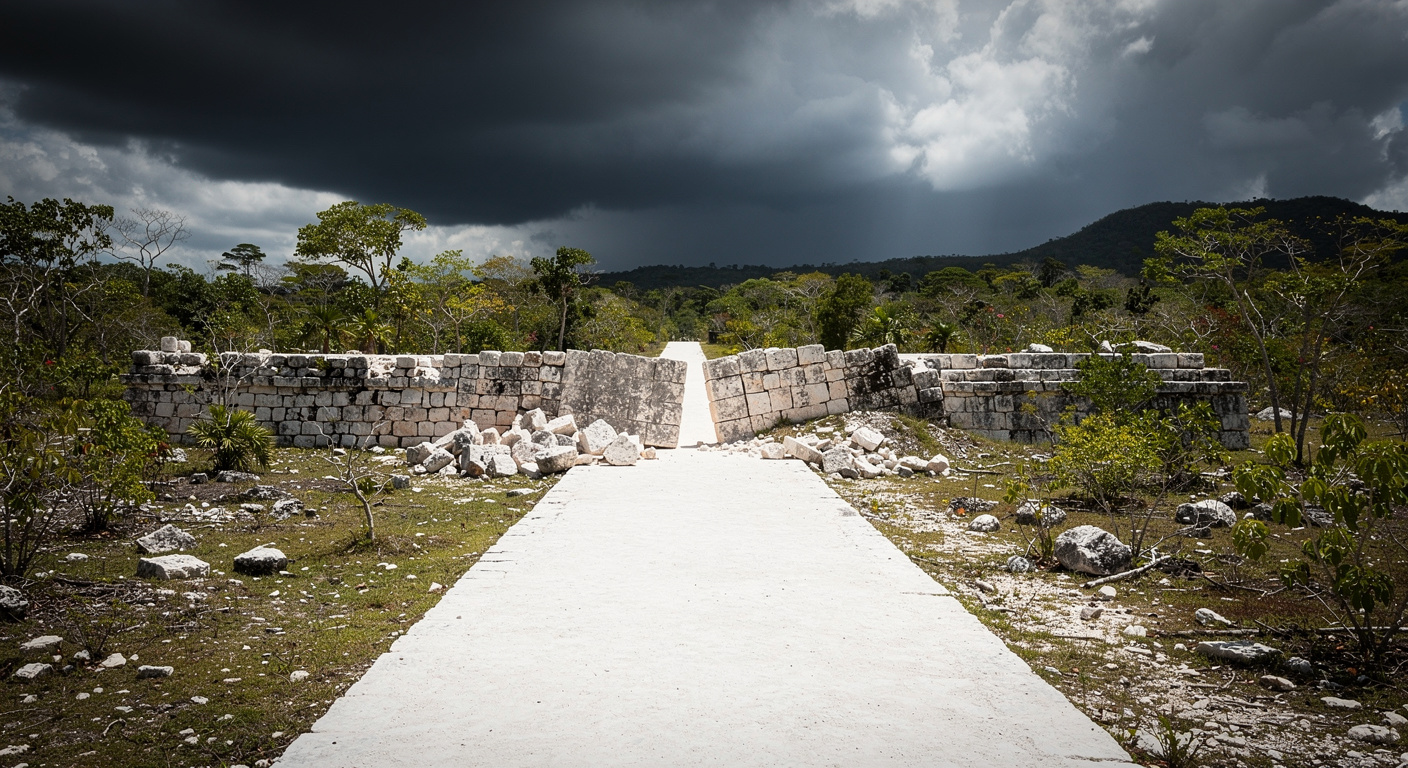
Some time after the southern cities began to falter, the builders of Aké erected a wall that cut cleanly across a 32-kilometer (20-mile) limestone road. This barrier, bypassing the ceremonial core, enclosed the temples and palaces while blocking traffic to the city of Izamal, located to the east.
Scientists extracted a sediment core from this lake in the Yucatán to detect signs of drought using oxygen data. This mud core preserved oxygen isotopes—tiny chemical variations linked to precipitation—whose pattern corresponded to long dry spells. As the drought persisted, agriculture failed more readily, and political agreements broke down faster than the stone buildings could crumble.
The End of Royal Authority and Architectural Adaptation
The Rise and Fall of Mayapan: A New Political Model
Around the year 1100, Mayapan rose to prominence as a capital ruled by powerful families, rather than by a single god-king. The council’s leaders drew people to the city; strontium isotopes—chemical signatures reflecting local geology—made it possible to trace the origins of these newcomers through analysis of their teeth.
Politics in Mayapan then descended into carnage as rival lineages fought for control. Skeletal injuries increased during the driest years, linking climate stress to civil conflict and the city’s collapse. Once the drought took hold, food shortages exacerbated long-standing feuds, and rulers could no longer feed the masses or secure their loyalty. Abandonment followed, yet many Mayan political and economic ties survived beyond the city walls into the following century.
A Transformation of Identity Rather Than a Disappearance
After the major cities emptied out, many Maya families moved to small villages, often closer to the peninsula’s coast and trade routes. Since these thatched-roof houses rotted away quickly, later archaeologists were left with scant evidence when searching for post-crisis communities. At the modern site of Aké, dwellings still abut the ancient foundations, showing how the place continued to serve as a setting for new lives.
This survival left fewer monuments to photograph, but it reshaped identity by replacing divine kingship with local decision-making. The ruins of Aké and Mayapan show how people regrouped after the drought by building homes from old stones, prioritizing adaptation over extinction.
As Lizzie Wade writes: “We do not yet have the same kind of historical perspective on our own era that archaeologists have on the collapse of the Classic Maya.” Her account provides readers with a record of adaptation, showing how communities carried on with what worked and abandoned what failed.
Source: earth.com
From Pyramids to Huts: The Little-Known Survival of the Maya After the Climate Collapse


