

Alien Weather Beyond Imagination
The Unusual Profile of an Overheated Gas Giant
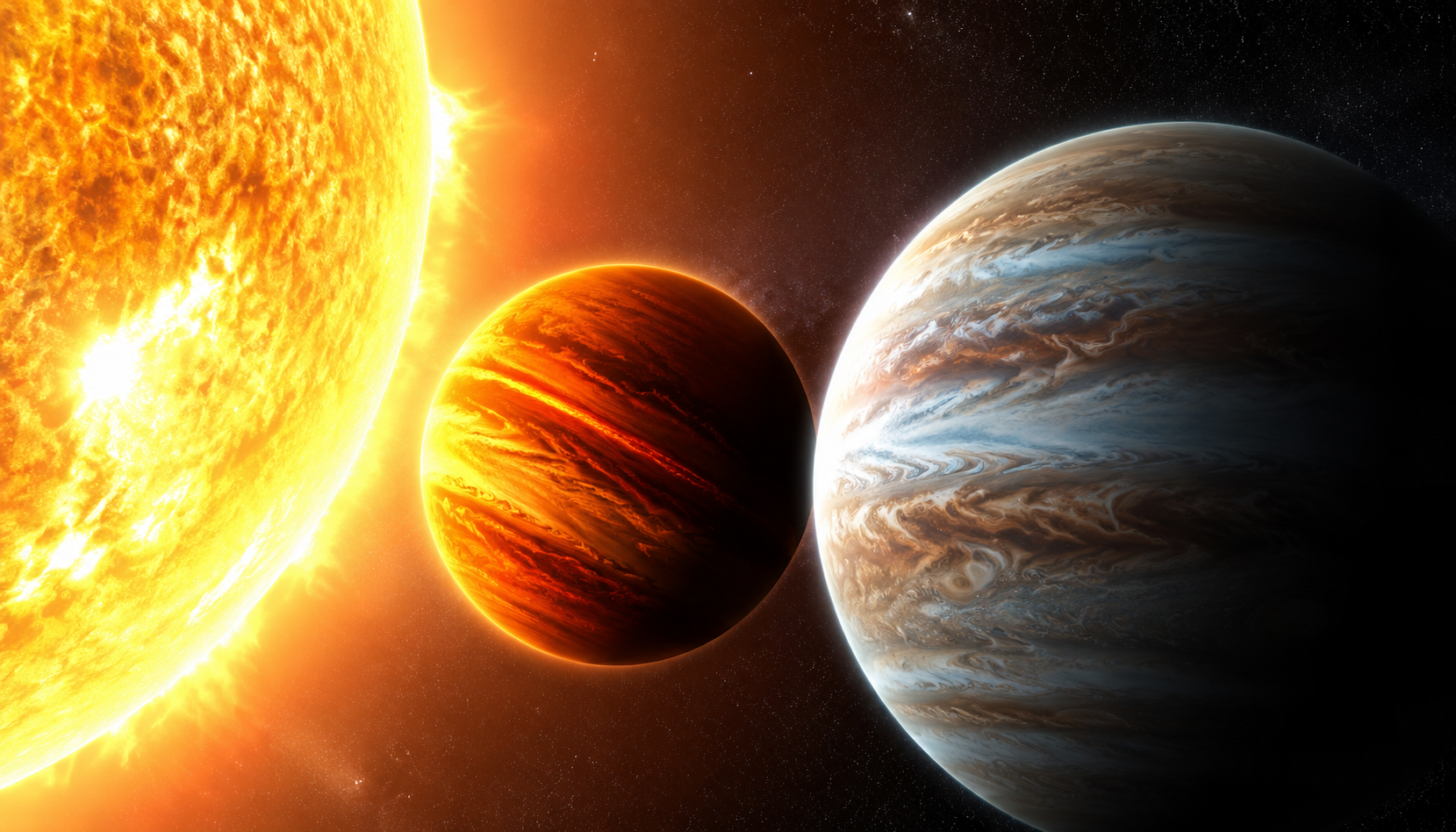
WASP-94A b belongs to the fascinating category of “hot Jupiters.” This gaseous behemoth has an impressive radius, equivalent to 1.58 times that of Jupiter, the largest planet in our own solar system. Its orbit is so tight around its host star that it remains at a distance of just 0.055 astronomical units (AU)—where one AU represents the average distance between Earth and the Sun. By comparison, this orbit is significantly closer than Mercury’s orbit around our Sun.
Due to this extreme proximity, it takes this exoplanet only four days to complete one full orbit. Beyond its dizzying orbit, WASP-94A b has long posed a challenge to researchers. Initial analyses suggested that its atmosphere contained hundreds of times more carbon and oxygen than Jupiter’s, a finding that challenged established models of how such planets form.
This initial mystery was finally resolved by new, much more precise measurements. The scientific team recently determined that the gas giant actually contains about five times the amount of oxygen and carbon found on Jupiter. This reassessment brings the planet’s composition back to a perfectly plausible level, fitting seamlessly into current models of planetary formation.
The James Webb Telescope Is a Game-Changer

"With the Hubble Space Telescope, when we used to make this type of observation, we would get an average view of the entire planet, with data from the clouds and the atmosphere smeared together and indistinguishable,” explained Sagnick Mukherjee, lead author of the study and a postdoctoral researcher at Arizona State University—who was a student at Johns Hopkins University and UC Santa Cruz at the time of this work—in an official statement. “This approach with the JWST allows us to pinpoint our observations, which has helped us see the cloud cycle.”
David Sing, a co-author of the study and the Bloomberg Distinguished Professor of Earth and Planetary Sciences at Johns Hopkins University, highlighted the significance of this breakthrough. “I’ve been observing exoplanets for 20 years, and general cloud cover has been a thorn in our side. We’ve known for some time that clouds are ubiquitous on hot Jupiter-type planets, which is frustrating because it’s like trying to look at the planet through a fogged-up window,” he explained. "Not only have we been able to clear the view, but we can finally determine what the clouds are made of and how they condense and evaporate as they move around the planet."
A Striking Meteorological Dichotomy
During the exoplanet’s transit, astronomers achieved the feat of distinguishing the leading edge of the planet—which corresponds to morning—from its trailing edge, which represents evening. WASP-94A b is a tidally locked planet, meaning it always faces its star with the same side. The day side, which is perpetually exposed, experiences scorching temperatures estimated at over 1,000 °C (1,832 °F). This scorching zone could not be observed directly because it was facing the star from Earth’s perspective.
The data revealed a striking contrast between the morning and evening hemispheres. On the morning side, the atmosphere is saturated with dense clouds composed of magnesium silicate, a mineral abundant in Earth’s rocks. In contrast, the evening side shows virtually no trace of these cloud formations. “It was a huge surprise. People expected some differences, such as it being cooler in the morning than in the evening—that’s something natural that we experience here on Earth,” added David Sing. "But what we saw was a true dichotomy between the weather on the two sides of the planet, and enormous differences in cloud cover, and that changes our entire picture of the planet."
The exact nature of these minerals is still subject to some technical nuances. The researchers note in their publication: “We cannot determine the specific species responsible for the clouds based on our observed spectrum.” They go on to add that “the silicate clouds could be composed of other Si-containing minerals, such as forsterite (Mg₂SiO₄) or quartz (SiO₂), rather than MgSiO₃ [magnesium silicate], but this does not affect our conclusions.”
Evaporation or howling winds: the hypotheses at play
Faced with this phenomenon of mineral clouds appearing and then disappearing as the day-night cycle progresses, researchers have formulated two main hypotheses to explain this sudden disappearance on the night side. The first theory suggests that these rock clusters simply evaporate as they enter the scorching heat on the day side, much like terrestrial morning fog that dissipates under the sun’s rays—but in this case involving solid minerals. The second theory proposes that these clouds could be swept up and engulfed in the depths of the day-side atmosphere by winds of unprecedented violence—veritable howling storms on a planetary scale.
Source: iflscience.com
The exoplanet WASP-94A b: an extreme world where clouds of rock form in the morning and disappear at night


