

A biological anomaly that defies mathematical models
The findings of this research, published in the scientific journal Nature, reveal an internal mechanism of remarkable efficiency. The research team, led primarily by scientists from the University of Missouri, had to dissect the animal’s genome to understand how such a lineage could persist without the DNA renewal inherent in conventional reproduction.
Gynogenesis, or the art of doing without males
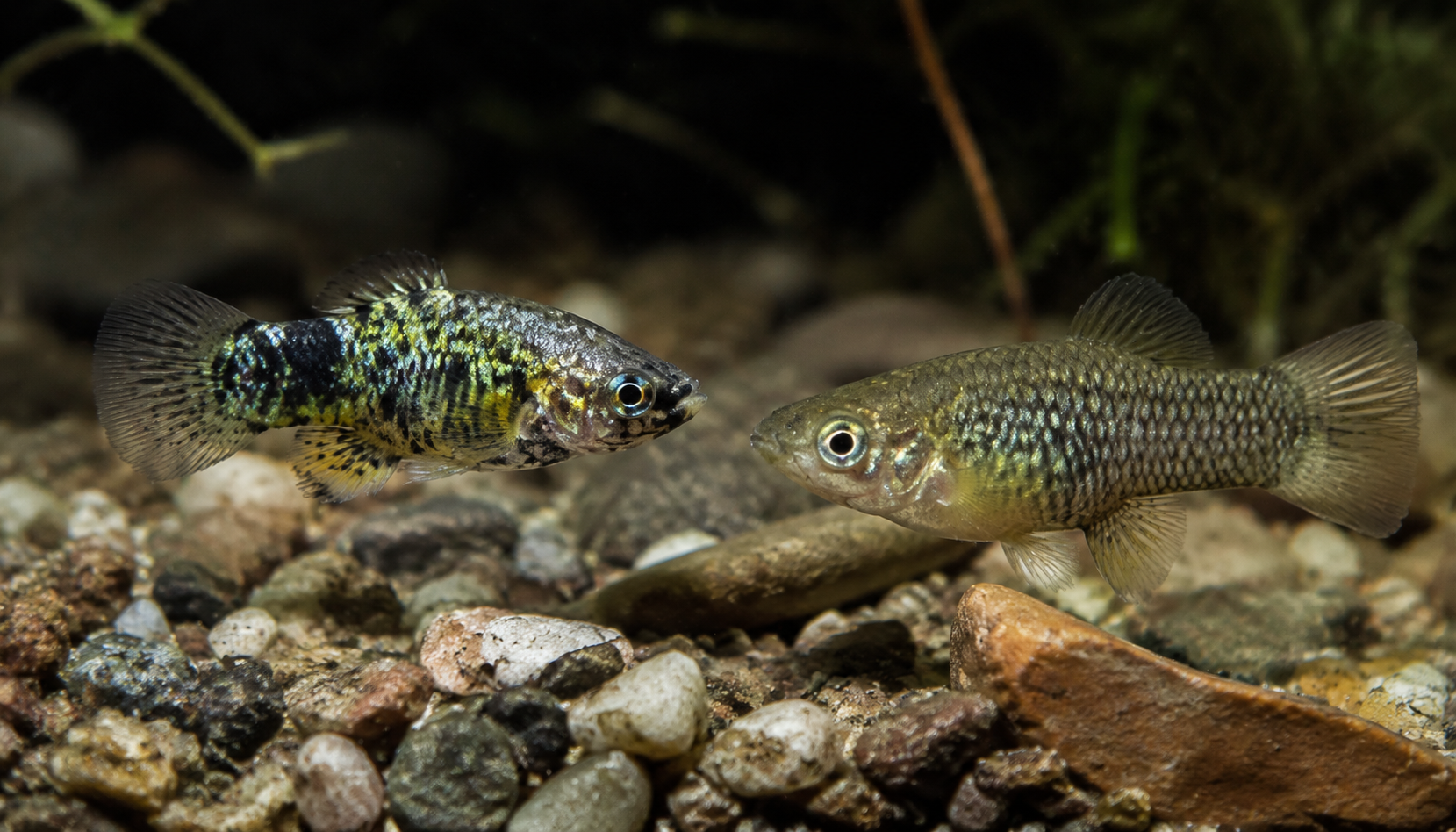
The Amazon molly’s prolonged survival relies on a very specific reproductive process called gynogenesis. Unlike species that rely on standard sexual reproduction, females of this species do not need to incorporate genetic material from a male to produce a new generation. They produce offspring that are exact clones of themselves.
However, the process still requires interaction with males from distinct but closely related species. The females use the sperm from these males solely as a physical trigger to initiate egg production. Once this stimulation has taken place, the male DNA is simply expelled and destroyed by the mother’s body.
Wes Warren, a principal investigator at the Bond Life Sciences Center at the University of Missouri, commented on this dynamic in a press release from the institution. "If a genome is supposed to degrade and it doesn’t, why not? As curious researchers, we were eager to find out. This fish seems to have the best of both worlds: the genetic health that normally comes from sexual reproduction, while not needing male DNA to reproduce."
Muller’s Ratchet and the Threat of Mutations
In theory, the permanent cloning system should function for only a limited period. The absence of new DNA derived from sexual reproduction exposes the species to an evolutionary phenomenon known as “Muller’s ratchet.” This principle posits that, without genetic mixing, harmful mutations inevitably accumulate in an organism’s genome from one generation to the next.
This accumulation of genetic defects should logically undermine the population’s viability and ultimately lead to the species’ total extinction. Scientists who analyzed the Amazon molly did indeed find that the expected mutations had indeed accumulated in the genome of these fish. The paradox of their survival therefore remained intact in the face of this measurable deterioration.
To solve this puzzle, the team turned its attention to internal cellular repair processes. As reported by the British media outlet BBC Future, Edward Ricemeyer, the study’s lead author, highlighted the flaw in existing models. “There was a missing piece to the theory,” he said. “And that piece was gene conversion.”
A dual genetic safeguard resulting from hybridization
The precision of this defense mechanism particularly surprised researchers. During his interview with the BBC, Edward Ricemeyer detailed the location of these repairs: “The types of mutations you’d expect to be the worst—the most dangerous, the most harmful—are the exact locations in the genome where we see gene conversion occurring most frequently.”
Asymmetric mutation rates and new perspectives

This observation initially raised doubts within the scientific community. “It was shocking because it goes against everything scientists thought they understood about mutation rates,” Edward Ricemeyer said in the university’s press release. “When we submitted our work to the journal, the reviewers didn’t believe us at first. They were just as surprised as we were, and asked us to provide much more evidence.”
The findings from the study of the Amazon molly could extend beyond the field of marine biology. Scientists believe this genetic conversion could occur in other species that reproduce through asexual cloning, offering a way to maintain a healthy genome for much longer than previously thought. "Better understanding the different ways reproduction occurs helps us better understand ourselves," concluded the study’s lead author. "How we got here, and where we might be headed."
Source: iflscience.com
These all-female fish should have gone extinct millennia ago, but genetics had other plans


