

A Cosmic Treasure 12 Billion Light-Years Away
Sometimes, the universe holds surprises that delight astronomers. Such is the case with a monumental discovery: the largest and most distant reservoir of water ever observed in the cosmos. At the heart of this discovery lies a celestial object named APM 08279+5255. It is a quasar—an active galaxy whose central supermassive black hole feeds on gas and, in turn, emits colossal amounts of light.
The mass of water detected is simply staggering. It is equivalent to about 140 thousand billion times the total amount of water contained in our planet’s oceans. This immense reservoir surrounds an insatiable supermassive black hole, located more than 12 billion light-years from Earth. Observing such a phenomenon is like looking back in time to an era when the universe was still young.
A discovery made by two separate teams
This discovery is the result of work by two teams of researchers. Matt Bradford, a scientist at NASA’s Jet Propulsion Laboratory in Pasadena, California, led one of them. He highlights the exceptional nature of this cosmic environment: “The environment around this quasar is quite unique in that it produces this enormous mass of water,” he said. “This is further evidence that water is ubiquitous in the universe, even in its earliest stages.”
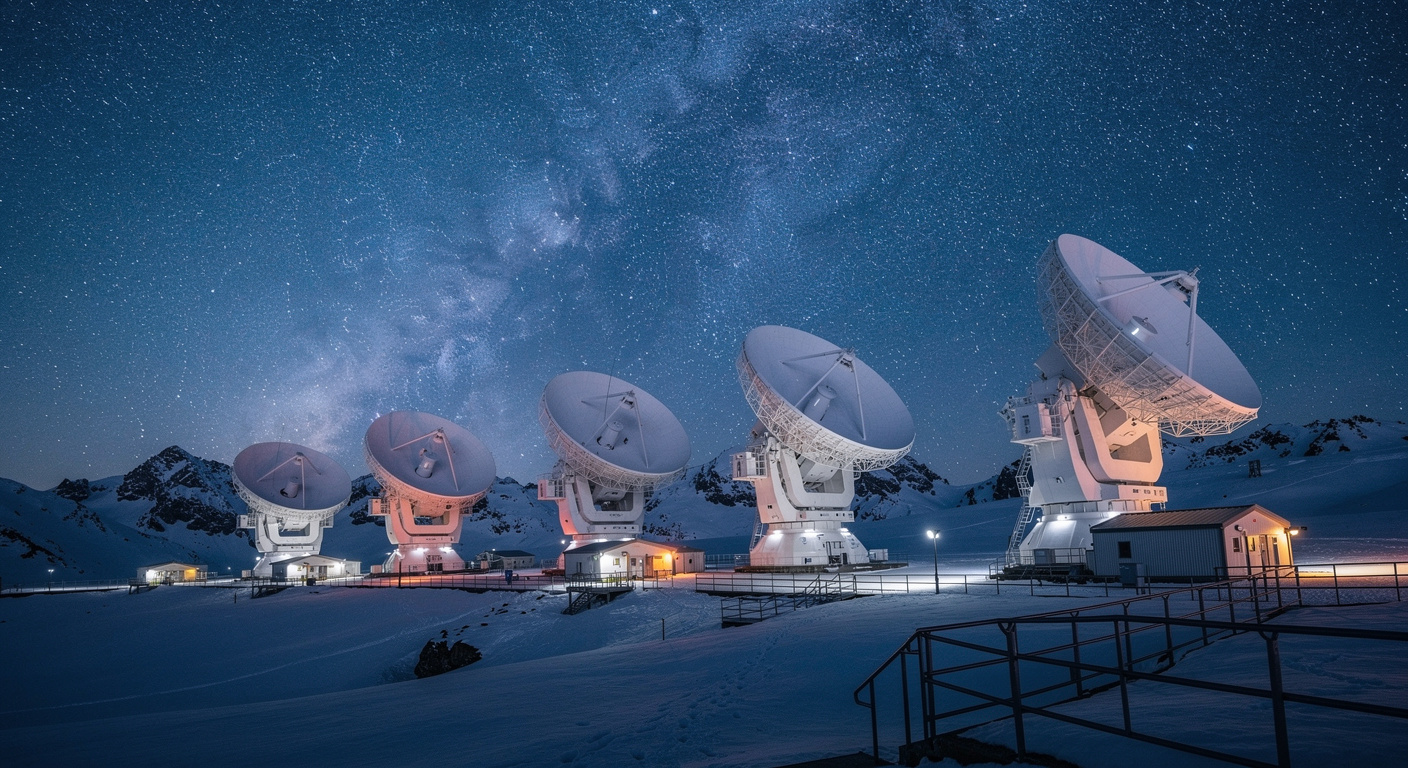
A second team, led by Dariusz Lis, a senior research associate in physics at Caltech and deputy director of the Caltech Submillimeter Observatory, used the Plateau de Bure Interferometer in the French Alps to detect the water. They serendipitously detected the presence of water vapor in APM 08279+5255 through a single spectral signature. It was Bradford’s team that later identified several spectral lines of water, revealing far more details, including the colossal mass of the gas cloud.
Redshift: A Time Machine
To probe the universe’s past, astronomers use a key measurement: redshift. As space itself expands, the light traveling through it is also stretched. This stretching shifts its color toward the red end of the light spectrum. The redshift measured for this quasar is approximately z ≈ 3.87.
A “BAL” Quasar and Its Cosmic Winds
APM 08279+5255 belongs to a specific class of quasars known as “BAL” quasars, an acronym for “Broad Absorption Line Quasar.” In practical terms, this means that its light spectrum exhibits broad dips, as if something had “absorbed” part of the light. These dips are created by extremely fast gas winds.
This gas is ejected from the central region at speeds of several thousand kilometers per second and absorbs some of the light emitted behind it. These winds provide a direct view of a phenomenon called “feedback.” Water vapor and other materials falling toward the black hole can also be propelled outward, heating and pushing back the surrounding gas. This intense activity shapes how stars form and how the host galaxy evolves.
The Mystery of Unusually High Luminosity
How powerful is this quasar really? Initial estimates of its bolometric luminosity—its total power across all wavelengths—ranged from several quadrillion times the luminosity of our Sun. These figures are so high that they warrant verification. Is the quasar really that powerful, or is a phenomenon along our line of sight amplifying its apparent brightness?
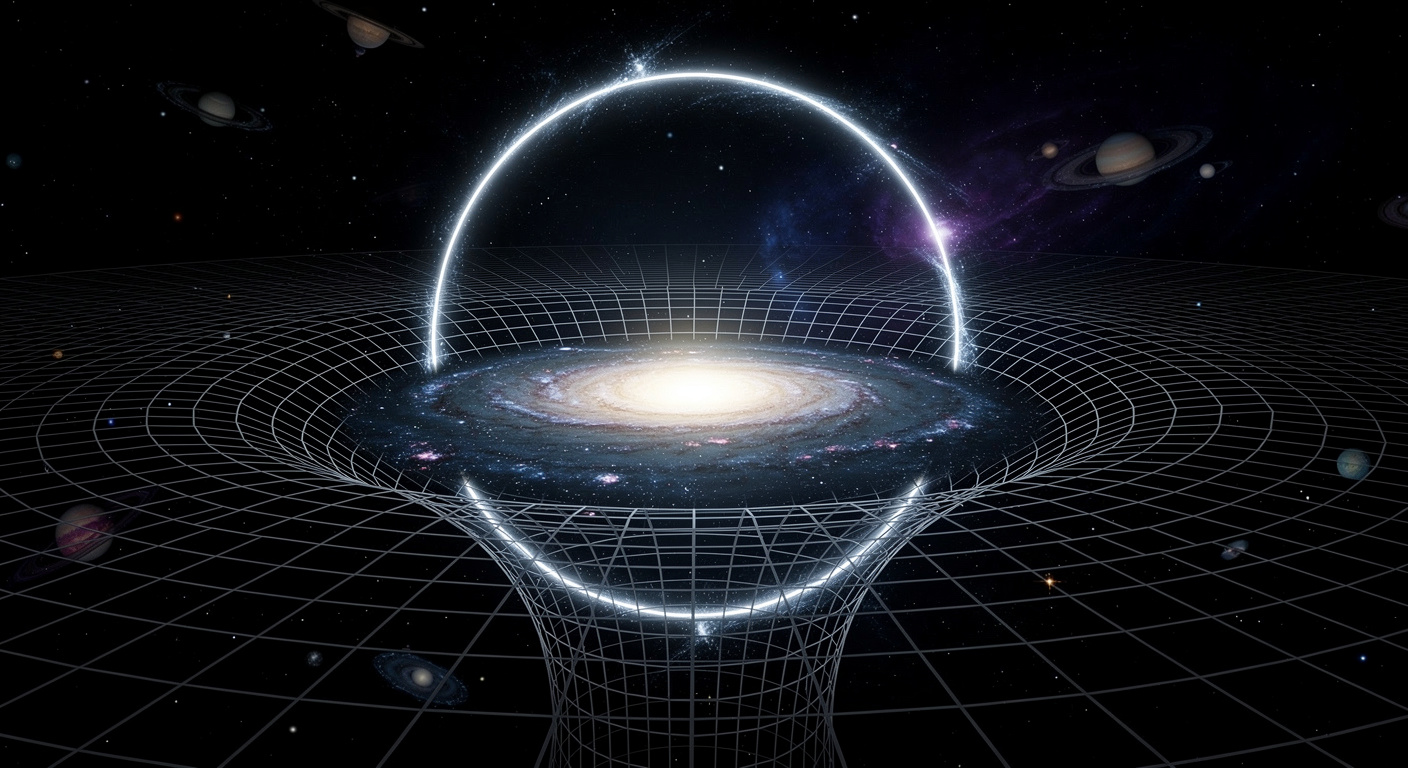
When objects appear too bright for their distance, astronomers suspect a gravitational lensing effect. This phenomenon occurs when massive objects, such as a galaxy, warp spacetime around them and can thus amplify the light from background sources. If a galaxy lies almost directly between us and a distant quasar, the quasar’s light can be intensified or even split into multiple images. Indeed, the images of APM 08279+5255 show a source that is not perfectly point-like: it appears slightly elongated, as if two very close images were merging into one another.
The gravitational magnifying glass: a natural telescope
To test this hypothesis, the researchers used a simple lens model—a sort of “baseline model” for a plausible foreground galaxy. The results suggest that the quasar’s visible light could be amplified by a factor of about 40. This is a considerable increase. But even after correcting for this effect and “demagnifying” the observed flux, the quasar still shines with prodigious intrinsic power, on the order of at least one hundred thousand billion suns.
Dust, Radio Waves, and X-Rays: The Pieces of the Puzzle
Brightness alone never tells the whole story. Scientists therefore compared the quasar’s light across many wavelengths. Its spectral energy distribution (SED) shows strong emission in the far infrared as well as in the visible spectrum. This profile is a sign of a dust-rich system: dust near the active nucleus absorbs high-energy radiation and re-emits it at longer wavelengths.
Lessons from a Cosmic Giant

Studies of this quasar show that there is enough gas—in the form of water vapor and other molecules such as carbon monoxide—to allow the black hole to grow to six times its current size. However, astronomers note that this is not a certainty: some of the gas could condense to form new stars or be completely blown away from the quasar. Ultimately, every new discovery of this kind offers a window into the early days of our universe—and into how gravity itself helps us study it.
Bradford’s paper, titled “The water vapor spectrum of APM 08279+5255,” lists among its co-authors Hien Nguyen, Jamie Bock, Jonas Zmuidzinas, and Bret Naylor of JPL; Alberto Bolatto of the University of Maryland, College Park; Phillip Maloney, Jason Glenn, and Julia Kamenetzky of the University of Colorado, Boulder; James Aguirre, Roxana Lupu, and Kimberly Scott of the University of Pennsylvania, Philadelphia; Hideo Matsuhara of the Institute of Space and Astronautical Science in Japan; and Eric Murphy of the Carnegie Institution for Science, Pasadena. Funding for Z-Spec was provided by the National Science Foundation, NASA, the Research Corporation, and partner institutions. The full study was published in the journal Astrophysical Journal Letters.
Source: earth.com
Black hole discovered containing enough water to fill ‘trillions of Earth-sized oceans’


