

A future straight out of a science fiction movie?
Pangea Ultima: The Supercontinent Trap
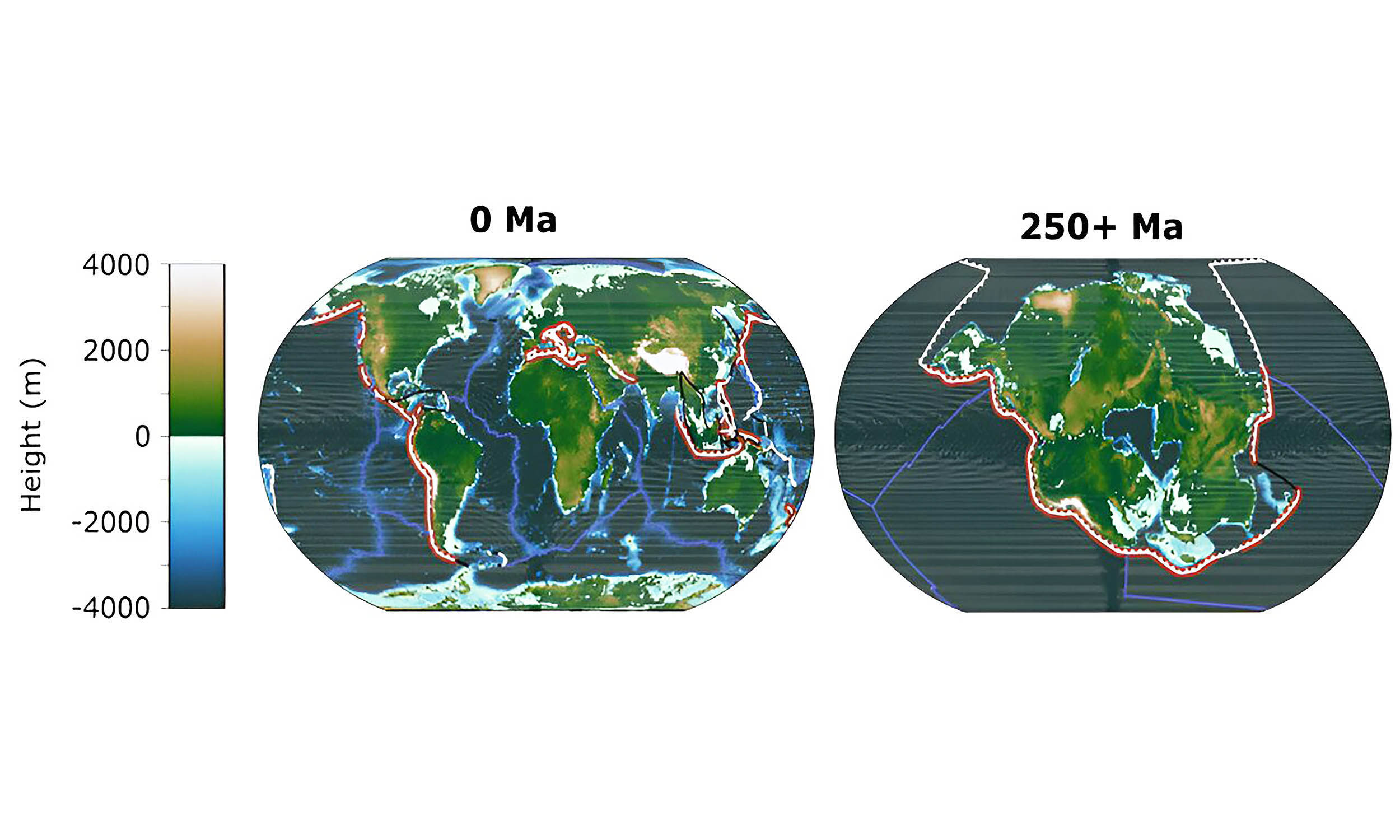
Geologists have long maintained that the Earth’s continents are gradually shifting. Pangea Ultima is the name given to the hypothetical supercontinent that could emerge in several million years. If this scenario were to play out, much of the landmass would find itself far from the cooling influence of the oceans—a phenomenon known as the continental effect.
This configuration would create a formidable combination. As Dr. Alexander Farnsworth explains: “The newly formed supercontinent would create a triple whammy, combining the continentality effect, a hotter sun, and more CO₂ in the atmosphere, increasing heat across much of the planet.”
When the body can no longer cool itself
In such an environment, temperatures could reach levels unsustainable for mammalian life. “Widespread temperatures ranging from 40 to 50 degrees Celsius (104 to 122 degrees Fahrenheit), and even higher daily extremes, compounded by high humidity levels, would ultimately seal our fate,” adds Dr. Farnsworth. He explains the fatal mechanism: “Humans—along with many other species—would die because of their inability to dissipate this heat through sweating to cool their bodies.”
The researchers emphasize that while mammals have historically adapted to temperature changes—notably by developing thicker fur or hibernating—sustained heat is far more difficult to cope with. Sweating is essential for regulating body temperature. Faced with persistent heat, without access to cool shelters and reliable water sources, this balance is disrupted.
The study’s projections are stark: only 8% to 16% of the land on this future supercontinent would remain within a tolerable temperature range. Widespread drought would limit access to water and reduce vegetation, making the search for food and hydration nearly impossible.
A Distant Echo of the Current Climate Crisis
Despite the distant time frame of this prediction, the authors emphasize the urgency of current challenges. “It is vitally important not to lose sight of our current climate crisis, which is the result of human-caused greenhouse gas emissions,” warns co-author Dr. Eunice Lo, a researcher in climate change and health at the University of Bristol.
She draws a direct parallel: “While we predict a planet that will be uninhabitable in 250 million years, we are already experiencing extreme heat today that is harmful to human health. That is why it is crucial to achieve carbon neutrality as quickly as possible.” Indeed, the past few decades have seen a rise in temperatures that is putting a strain on our resources. Heat waves threaten crops, disrupt energy grids, and endanger communities.
CO2: A Key Player in the Distant Future
To estimate future levels of carbon dioxide, the study relied on models of tectonics and ocean chemistry. Projections indicate that increased volcanic outgassing over the next eons will push CO₂ concentrations well above 600 parts per million (ppm), compared to about 400 ppm today. Such levels would create hostile conditions for many organisms.
“We believe that CO2 could rise from about 400 parts per million (ppm) today to over 600 ppm in several million years,” notes Professor Benjamin Mills of the University of Leeds. He adds a crucial caveat: “Of course, this assumes that humans will stop burning fossil fuels; otherwise, we’ll see these figures much, much sooner.”
Lessons from the Past: The Ordovician–Silurian Extinction
Earth’s history is punctuated by events of severe biodiversity loss, serving as a reminder of the fragility of life. One of the earliest known major mass extinctions is the Ordovician–Silurian extinction, which occurred about 443 million years ago.
Lessons from the Past: The Upper Devonian Crisis
Lessons from the Past: The Permian–Triassic “Great Dying”
The most devastating extinction of all time remains the Permian–Triassic extinction, which occurred approximately 252 million years ago. Often referred to as the “Great Dying,” it nearly led to the total eradication of complex life on our planet.
The figures are staggering: more than 90% of marine species and 70% of terrestrial species were wiped out. This event underscores the vulnerability of life—even terrestrial life—in the face of large-scale climatic and geological upheavals.
Lessons from the Past: The Triassic–Jurassic Extinction
About 200 million years ago, Earth experienced another major extinction event: the Triassic–Jurassic extinction. Triggered by massive volcanic eruptions, this crisis led to the loss of approximately half of all existing species.
Lessons from the Past: The End of the Dinosaurs
The most famous extinction is undoubtedly the Cretaceous–Paleogene extinction event, which occurred 66 million years ago. Triggered by an asteroid impact, it brought an end to the reign of non-avian dinosaurs and wiped out approximately 75% of all species on Earth.
This catastrophe allowed mammals—then small creatures—to diversify and occupy the ecological niches left vacant. It is from this event that the emergence of the human species indirectly stems.
What if the key lies beyond Earth?
This analysis has implications that extend beyond our own planet. It broadens the way scientists assess the habitability of exoplanets. Even if a world lies within its star’s “habitable zone”—a region where liquid water could exist—the melting of its continents could cause temperatures to soar, rendering it barren.
Researchers believe that other planets could undergo similar changes, where tectonic movements and solar intensity drive up temperatures. Rotational speed and atmospheric chemistry can also affect habitability. For Dr. Farnsworth, the conclusion is clear: “This work also highlights that a world located in the so-called ‘habitable zone’ of a solar system might not be the most hospitable for humans, depending on whether the continents are scattered, as they are today, or clustered into a single large supercontinent.”
Ultimately, “Understanding these configurations can guide experts searching for environments conducive to life beyond Earth.” While the prospect of a distant supercontinent may seem abstract, it reminds us of the importance of the delicate balances that make our world habitable today—and the need to take meaningful steps to preserve it.
Source: earth.com
Scientists predict how and when all mammals, including humans, might become extinct


