

The Proton’s Size Recalculated: This Record-Breaking Accuracy Restricts the Search for New Physics


A Major Breakthrough from Germany
Physicists based in Germany have just taken a crucial step forward in understanding the infinitely small. They have achieved the most precise measurement to date of the proton’s width. This feat is the work of Lothar Maisenbacher and his colleagues at the Max Planck Institute for Quantum Optics. To achieve this, the team examined a previously unexplored energy-level transition within the hydrogen atom.
The results of this in-depth study have demonstrated that the Standard Model continues to hold up, even when subjected to extraordinarily rigorous scrutiny. This robustness leaves even less room than before for rival theories that contradict our current best understanding of the universe’s behavior. This research has been officially published in the prestigious journal Nature.
Quantum Electrodynamics Put to the Test
However, for a physical theory to remain viable, its predictions must be confirmed by actual experiments. Over decades of increasingly precise measurements, researchers have repeatedly tested QED’s predictions, often obtaining strikingly similar results. It is this consistency that has established the reputation of this theoretical model as a robust framework.
But alongside these confirmations, scientists have been searching for even the slightest deviations. The goal is to detect what might resemble cracks in the Standard Model—clues that could point to new, as yet unexplained physics. The search for these anomalies is the driving force behind current fundamental research.
The Challenge of the Proton’s Size
One of these crucial tests involves measuring the width of the proton, also known as the “charge radius.” In recent years, various experimental techniques have yielded slightly contradictory values for this quantity. These discrepancies have limited physicists’ ability to push QED tests to their ultimate precision, creating persistent uncertainty surrounding the true value of this radius.
In their study, Lothar Maisenbacher’s team set out to further tighten the constraints on QED. Their goal was to determine the proton’s charge radius with unprecedented precision. To make their measurement, they took into account the intrinsic link between the size of a proton and the exact positions of hydrogen’s energy levels.
The Hydrogen Atom as a Laboratory
However, at the extreme precision required to probe QED to its very limits, differences in experimental techniques and the associated uncertainties can lead to discrepancies between measurements. In the past, these inconsistencies have made it difficult to refine the proton’s radius and to continue testing QED’s predictions.
Unparalleled precision thanks to a new method
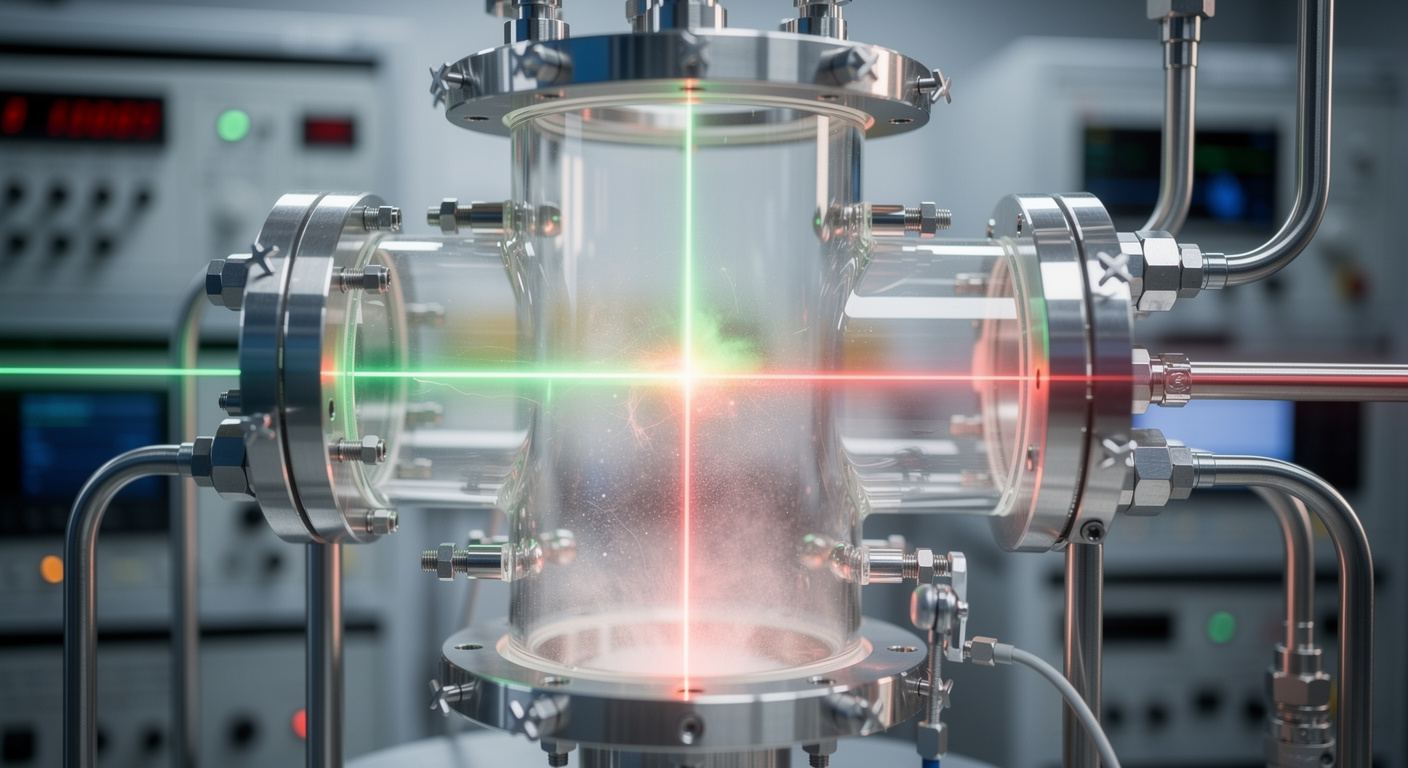
To meet this challenge, the team measured an energy-level transition that had not previously been explored at this level of precision: the transition from hydrogen’s 2S excited state to the even more highly excited 6P state. The 2S state is of particular interest because of its unusually long lifetime compared to most excited states, which provides a stable starting point for extremely precise measurements.
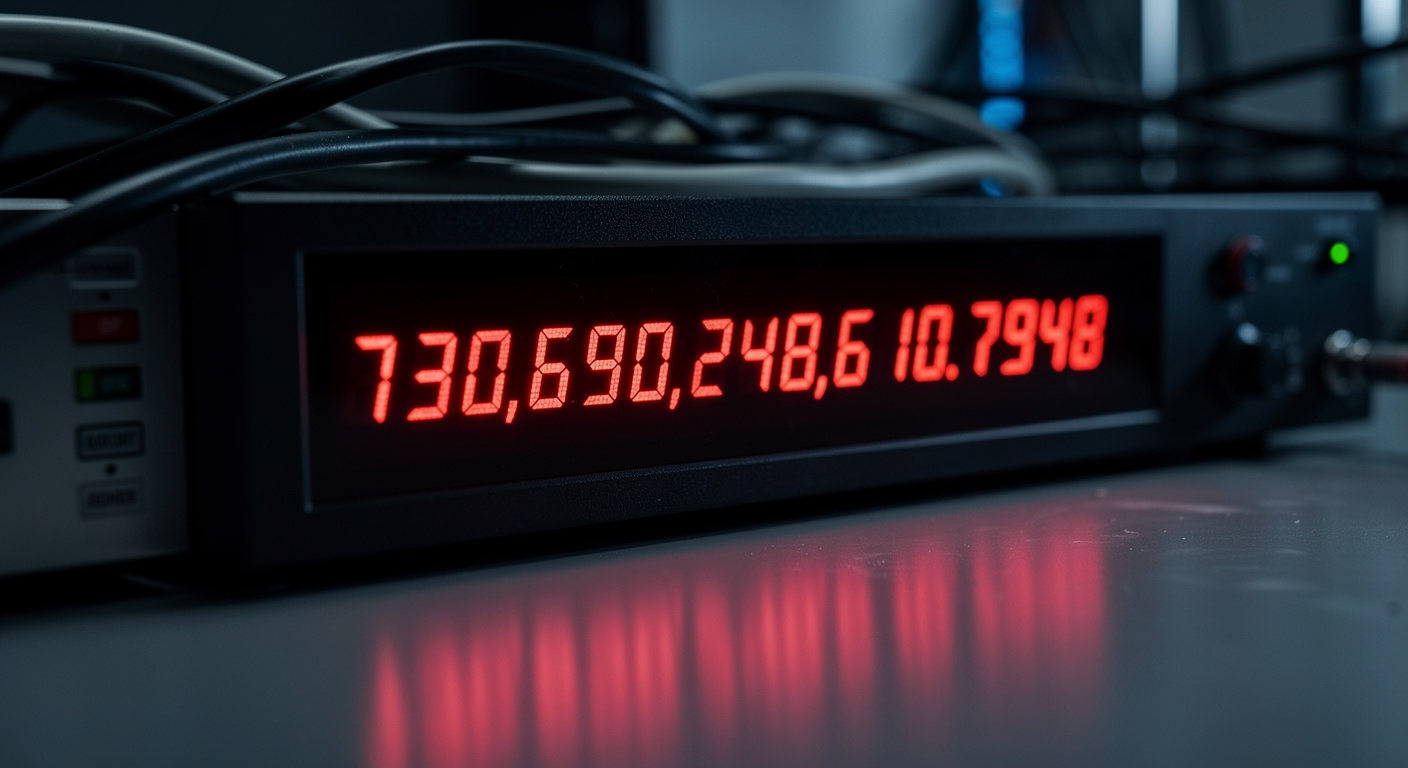
Using high-precision laser spectroscopy, the researchers measured the frequency of the transition photon. The result is astonishingly precise: 730,690,248,610.7948 kilohertz. This figure deviates by only 0.0025 kilohertz from the value predicted by the Standard Model—a minuscule discrepancy that attests to the rigor of the experiment.
From this frequency, they determined the proton’s charge radius to be 0.840615 femtometers. This result is approximately 2.5 times more precise than any previous value obtained from hydrogen energy level transitions. Crucially, this result is consistent with the smaller radius found in previous hydrogen experiments, thereby helping to resolve long-standing inconsistencies.
Conclusion: The Unassailable Standard Model

The noose is thus tightening around the known laws of the universe, confirming—for now—the robustness of our current understanding while defining the playing field for future scientific exploration with new clarity.
Source: phys.org
Created by humans, assisted by AI.
The Proton’s Size Recalculated: This Record-Breaking Accuracy Restricts the Search for New Physics
This content was created with the help of AI.
