Skip to content

Immediate access—but to what truth?

Over the past forty years, technological advances have transformed our computers and mobile devices into the world’s largest library. Today, information is at our fingertips on our phones, tablets, and smartwatches, simplifying everything from access to entertainment to communication. The advent of generative artificial intelligence (GenAI) has further accelerated this trend: whether it’s locating where dinosaurs lived or measuring a heart rate, answers come faster than ever. However, a key question remains: does this speed guarantee accuracy?

This technology now has the power to influence how the past is visualized and represented. To assess its effects, researchers are studying the phenomenon, including Matthew Magnani, an assistant professor of anthropology at the University of Maine, and Jon Clindaniel, a specialist in computational anthropology at the University of Chicago. Together, they published their findings in the journal Advances in Archaeological Practice.

An experiment based on four scenarios

To conduct this study, which began in 2023, the two scholars designed a model based on centuries of scientific theory. Their goal: to understand how biases and misinformation are embedded in the everyday use of AI. They used two chatbots to generate images and narratives about the daily lives of Neanderthals. The protocol relied on four types of prompts, each tested 100 times, using DALL-E 3 for image generation and the ChatGPT API (GPT-3.5) for text.

Two of these prompts did not require scientific accuracy, while the other two explicitly called for it. Similarly, some prompts included specific contextual details, such as the subjects’ clothing or activities, while others remained more vague. Matthew Magnani emphasizes the importance of examining the biases built into these tools: “Is it common to receive outdated responses when we seek information from chatbots, and in which areas?”

Clichés from a bygone era
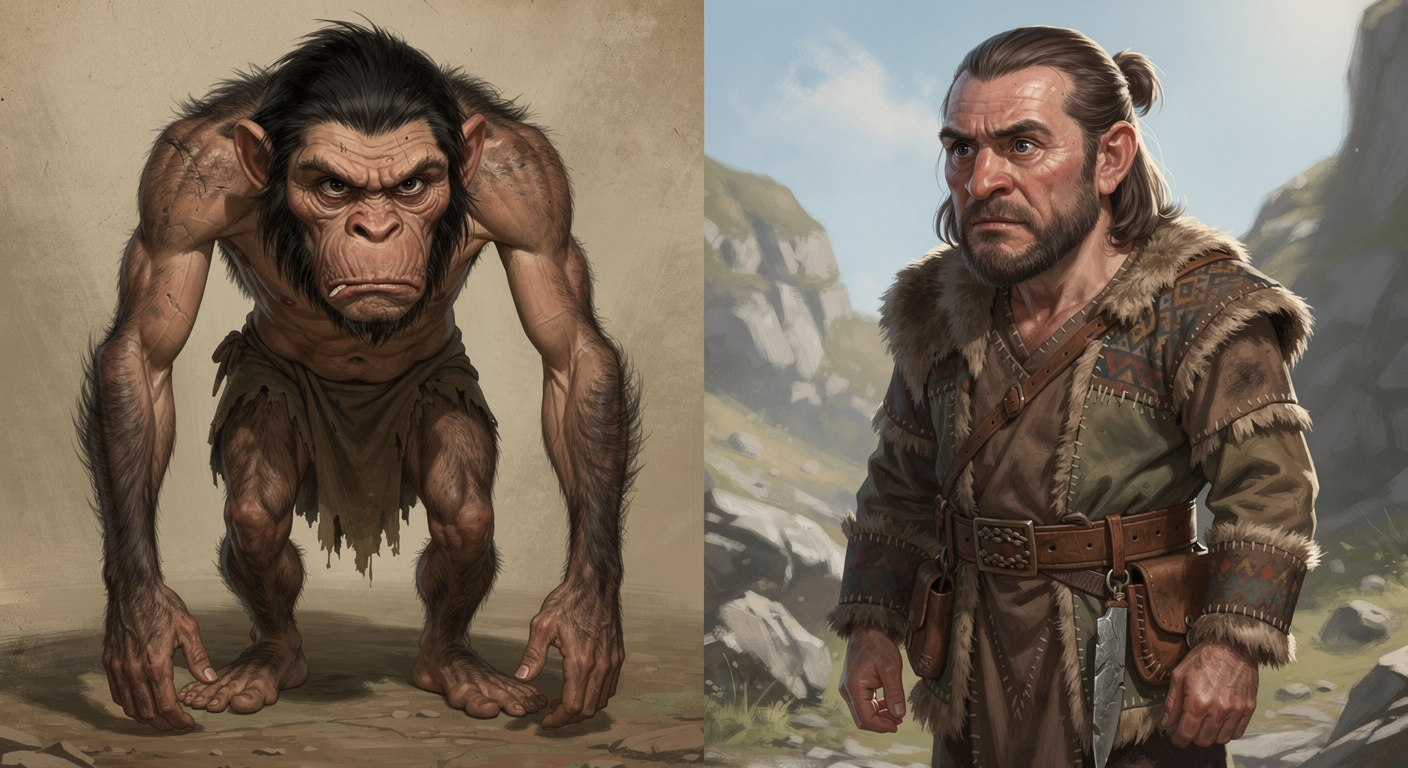
The choice of Neanderthals as a subject of study is no coincidence. Their skeletal remains were first depicted in 1864, and since then, the scientific understanding has evolved considerably, shifting from debates about their clothing to their hunting methods. This subject, where knowledge has fluctuated, serves as an ideal test case for evaluating AI sources. The results show that the generated images depict Neanderthals as they were imagined over 100 years ago: a primitive species with archaic features, hunched over, very hairy, and resembling chimpanzees more than humans. Notably, the images almost systematically lacked women and children.

In terms of narrative, the texts downplayed the sophistication and diversity of Neanderthal culture as understood by contemporary science. About half of the stories generated by ChatGPT did not align with current knowledge, a figure that rose to over 80% for one of the prompts. Furthermore, technological anachronisms appeared in both the texts and the images: basketry, thatched roofs, ladders, and even the presence of glass and metal—elements far too advanced for the era.

When Copyright Freezes Knowledge

By cross-referencing the generated content with different eras of scientific literature, Magnani and Clindaniel identified the source of the data used by the chatbots. ChatGPT produced content consistent with knowledge from the 1960s, while DALL-E 3 reflected research from the late 1980s and early 1990s. The explanation lies in part in data accessibility: copyright laws established in the 1920s restricted access to scholarly research until the advent of Open Access in the early 2000s.

Jon Clindaniel emphasizes that to achieve more accurate AI, it is crucial to make anthropological datasets and scholarly articles accessible to algorithms. Research access policies will directly influence how the past is imagined by these technologies.

Toward a Critical Use of Technology

Although generative AI has moved from the technological horizon to the forefront of society in just two years, caution remains warranted. If the study were repeated today, Matthew Magnani hopes the results would better incorporate recent research. Jon Clindaniel points out that AI remains a powerful tool for processing large volumes of information and detecting patterns, provided it is used competently and carefully.

This research, part of a series exploring the use of AI in archaeology, serves as a model for gauging the gap between academic knowledge and automatically generated content. “Teaching our students to approach generative AI with caution will foster a more technically literate and critical society,” concludes Magnani.

Source: phys.org

Created by humans, assisted by AI.

What Neanderthals Reveal About the True Reliability of Artificial Intelligence

This content was created with the help of AI.

facebook icon twitter icon linkedin icon
Copied!

Commentaires

0 0 votes
Article Rating
Subscribe
Notify of
guest
0 Comments
Newest
Oldest Most Voted
Inline Feedbacks
View all comments
More Content