

More Than Just a Morning Routine
Have you ever wondered, while brushing your teeth this morning, if this mundane act might hide something more than just a simple quest to prevent cavities? It’s a question that may seem strange, I’ll grant you that. Yet science has just given us a reason to look at our reflection differently. For years, we’ve viewed our mouths as nothing more than an entryway—a sort of mechanical corridor where we chew before swallowing. That’s all there was to it. But now, that simplistic view is being shattered.
A fascinating study, the results of which were released in late September 2025, suggests that our oral hygiene could be a window into our medical future—much sooner than we thought. This isn’t science fiction: researchers have discovered that the microbes living on our tongues and gums could predict the onset of pancreatic cancer years before any symptoms appear. It’s spine-chilling, but it also holds immense hope.
An invisible army: when 122,000 people shed light on the issue

Let’s get right to the heart of the matter, because the numbers are mind-boggling. This isn’t some small experiment conducted in a corner of a lab; the team at NYU Langone Health and the Perlmutter Cancer Center thought big. They analyzed the saliva of no fewer than 122,000 healthy people. Can you imagine the sheer volume of data? These volunteers were followed for nearly a decade as part of two massive U.S. epidemiological cohorts.
And what did they find when they delved into this microscopic world? This is where it gets incredible. Thanks to next-generation genetic sequencing—a technology that allows us to see what was invisible until recently—they identified 27 microbial species whose presence is a game-changer. Most surprisingly, 24 of these 27 species were completely unknown in this context. These aren’t just the usual culprits behind gum disease. The study reveals that the combined presence of these microorganisms triples the risk of developing pancreatic cancer. Yes, you read that right: the risk is tripled. This is a statistical link that can no longer be ignored, transforming oral microbiology into a potentially powerful screening tool.
Fungi and Mechanisms: The Enemy Comes from Within
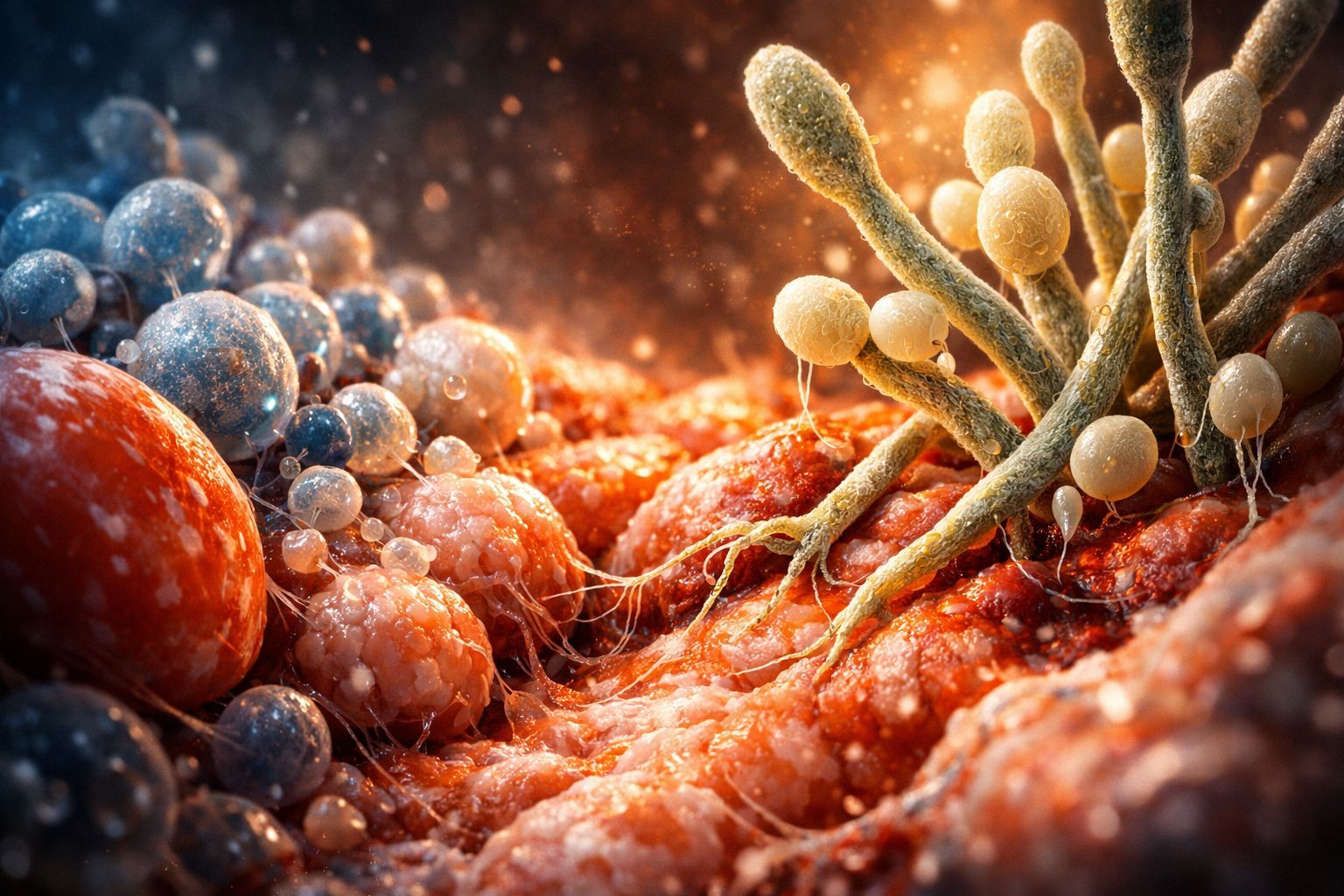
But wait—the story gets a little more complicated. We’re not just talking about bacteria here. Researchers have pinpointed something quite unexpected: fungi. More specifically, yeasts of the genus Candida. Usually, this type of yeast lives quietly on our skin or mucous membranes without causing any trouble. But when found deep within pancreatic tumors, it’s a whole different story… It seems to play a much more insidious role once it reaches the deep tissues.
How do these intruders make their way from your mouth to your pancreas? That’s the big question. The study, published in the prestigious journal JAMA Oncology, puts forward several hypotheses. The most likely one is that they simply hitch a ride: we swallow our saliva, the microbes migrate, perhaps cross the intestinal barriers, and—poof—off to the pancreas they go. Other theories suggest modulation of the immune system or the release of inflammatory toxins. Yixuan Meng and her colleagues, who conducted this research, have even developed a predictive score based on these 27 species. The idea? To target screening toward those with this specific microbial profile. It’s a bit like having a silent alarm system that goes off before a fire breaks out.
Conclusion: A Glimmer of Hope Against a Silent Killer

Why is all this so vital? Because pancreatic cancer is a nightmare. Let’s be honest—the statistics are terrifying. According to the American Cancer Society (figures reported by New Atlas), the five-year survival rate doesn’t exceed 8%. That’s alarmingly low. The main reason is that it’s often detected far too late, when symptoms are already present. That’s why this discovery is, in my opinion, revolutionary.
If we can use a simple saliva sample to identify people at risk years in advance, we’re completely shifting the paradigm. We’re moving from reaction to pure prevention. The body is an ecosystem; everything is connected. So tonight, when you reach for your dental floss or toothbrush, remind yourself that this small, seemingly insignificant gesture may have a much greater impact on your overall health than we ever imagined. It may, in the end, mark the beginning of a new era for personalized medicine.
What Your Mirror Hides From You: A Vital Clue May Be on Your Tongue
This content was created with the help of AI.


