

From the Stone Agora to Digital Chaos
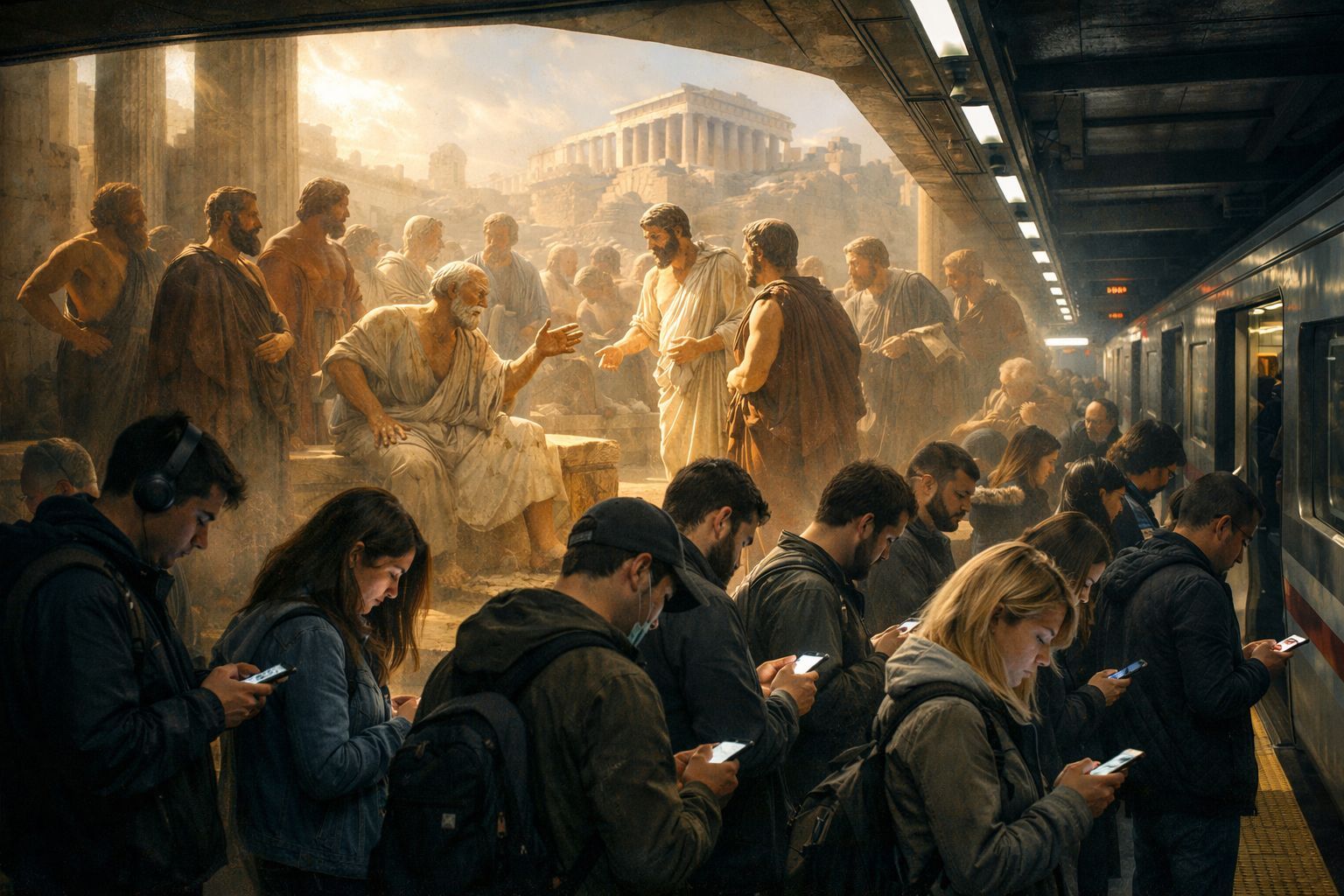
Imagine the scene for a moment. We’re in ancient Athens, at the Agora. It wasn’t just a marketplace—it was the beating heart of the city, a physical forum where citizens gathered to argue… well, to deliberate, I mean. They made decisions together, guided by strict social rules that ensured—as best they could—healthy debates. It was lively; it was human. Sara Kells, an expert in the humanities, reminds us just how structured that model was.
And today? Take a leap back in time. Our public squares are no longer made of stone; they’re made of pixels and cables. They’ve migrated to our screens, into the endless streams of social media. Except that here… well, it’s the Wild West. There are virtually no community rules, no implicit code of conduct like there was in the agora. Instead, we have opaque systems—those infamous algorithms—that arbitrarily decide who gets a voice and who must remain in the shadows.
We believed in that utopia for a long time, didn’t we? The idea of a “radically democratic” Internet. It seems so far away now… Almost naive. The reality is that our conversations are shaped by machines designed for one thing only: to maximize engagement. Not understanding, just clicks. It’s algorithmic popularity that calls the shots, certainly not the accuracy of facts or the diversity of opinions. That’s the paradox of our era: we’ve never had so much freedom of expression, and yet we’ve never been so limited by forces we have absolutely no control over.
Isegoria and Parrhesia: These Forgotten Words That Change Everything

Somewhere between the ancient streets of Athens and our touchscreens, we’ve lost something along the way. Something vital. It’s that fragile balance between the right to speak and the courage—yes, the courage—to tell the truth, even when things get heated for us. Loud voices drown everything out, nuances disappear, and outrage spreads faster than wildfire. To understand what we’ve lost, we need to dust off two ancient Athenian concepts: isegoria and parrhesia.
Isegoria isn’t just “the right to speak your mind.” In Athens, it ran much deeper. It was the idea of equality of speech, but above all, a shared responsibility. It meant that public life shouldn’t be the exclusive playground of the powerful. It was a commitment to fairness. And then there’s parrhesia. I love this concept. You could translate it as “freedom of expression,” but that would be an oversimplification. It’s boldness. Not the brutal, reckless frankness you see on Twitter—no… It’s ethical courage. The duty to speak the truth, even—and especially—when it makes you uncomfortable or puts you in danger.
These weren’t just abstract ideas. They were put into practice. They were concrete. The Athenians knew that democracy is something you learn, that it’s a muscle you have to exercise. Today, even though the playing field is digital, these virtues are more necessary than ever. Because access to a voice isn’t enough. Without standards to protect the truth, freedom of expression becomes just a tool for manipulation or intimidation. And I’m not even talking about the rise of AI, which further blurs the lines between what is human and what is machine.
When Algorithms Squeeze the Life Out of Courage and Nuance

Let’s face it: on our current platforms, being heard has become a privilege, not a right. Visibility is distributed in a completely unequal—and, frankly, unpredictable—way. Algorithms have this annoying bias: they amplify anything that tugs at the heartstrings or stirs strong emotions, regardless of whether it’s true or intelligent. The result? Marginalized communities are often ignored, while those who master the art of provocation dominate the debate. This is where isegoria takes a hit.
On paper, no one is excluded. But in reality? Many are structurally invisible. You have the right to speak, certainly, but good luck getting heard. And when it comes to parrhesia, it’s even worse. It’s become precarious, even dangerous. Dare to speak an uncomfortable truth, be honest about a sensitive topic, and you risk harassment, having your words twisted, or seeing your reputation destroyed in three clicks. The “price” of courage has skyrocketed.
Faced with this, the temptation is strong: either we stay silent, or we run off to hide in echo chambers where everyone agrees with us. It’s reassuring, but it’s deadly for democracy. Generative AI only adds to the pressure by flooding the internet with content that mimics human credibility without any moral intent. We’re swimming in a fog.
Conclusion: Rethinking Education, or How to Educate Citizens

So, what do we do? Do we just shut everything down? No, the solution may be older than we think. The Athenians understood that these virtues don’t just fall from the sky. Listening was a civic duty; speaking was a responsibility. Today, civic education must take the lead. We need to transform our classrooms into mini-agoras.
In practical terms, this means teaching students to navigate this ethical tension. Creating spaces where they practice verifying information, truly listening—what’s called “generous listening”—and debating respectfully, even when they disagree. This isn’t about dictating to young people what to think, but about giving them the tools to take responsibility for their own convictions. It’s all about practice. Learning to slow down the conversation where digital technology wants us to rush. Introducing reflection where algorithms want knee-jerk reactions.
Ultimately, the challenge isn’t technological; it’s educational. No computer code will teach you courage or fairness. You learn those by doing. If we want our digital spaces to be livable, we must prepare citizens to inhabit them. The public square has certainly changed, but the goal remains the same: to speak to one another as equals, with honesty. And that is still within our reach.
Why Your News Feed Would Make an Ancient Greek Cry
This content was created with the help of AI.


