

Scientific Consensus Put to the Test of Economic Costs

Current global climate models (GCMs), as presented in the IPCC’s Sixth Assessment Report (AR6) published in 2021, show a high level of confidence: virtually all of the surface warming observed since the pre-industrial period (1850–1900)—just over 1 °C—is attributed to rising greenhouse gas concentrations and other anthropogenic forcings. These projections, developed based on various socio-economic scenarios (SSPs), now form the foundation of global mitigation strategies aimed at carbon neutrality.
The prevailing view holds that only “net-zero” climate policies will keep future damage within acceptable limits. However, these policies entail extremely high economic and societal costs. This raises a crucial question: Does the current state of climate science fully justify these immediate and certain costs?
A study titled “Detection, attribution, and modeling of climate change: Key open issues,” published in the journal Gondwana Research, calls for a closer examination. By analyzing observational datasets, paleoclimate evidence, and model performance, this work reveals a far more complex picture than is generally accepted. These unresolved questions regarding the interpretation of past climates and the projection of future climates are critical, as they influence decisions that will shape economies for decades to come.
The Forgotten “Heartbeat” of Natural Variability

A central theme of this research is natural climate variability. During the Holocene—the last 11,700 years—the climate system has experienced a Climatic Optimum (6,000 to 8,000 years ago) and has undergone repeated oscillations: multi-decadal cycles, centennial fluctuations, and millennial-scale reorganizations. Some of these long-term cycles are well documented, such as the quasi-millennial Eddy cycle, associated with the Medieval and Roman Warm Periods, or the Hallstatt-Bray cycle, which lasted 2,000 to 2,500 years. These patterns are recorded in ice cores, marine sediments, tree rings, historical documents, and indirect records of solar activity.
The problem is that current GCM models struggle to reproduce the Holocene Optimum as well as these natural rhythms. While they do generate internal variability, it does not match the timing, amplitude, or persistence observed in nature. When a model fails to capture this natural “heartbeat” of the system, it becomes difficult to distinguish human-induced warming from natural background noise.
Uncertainties in Temperature Measurements: Surface vs. Satellite Data

A Complex Sun and “Overheated” Models
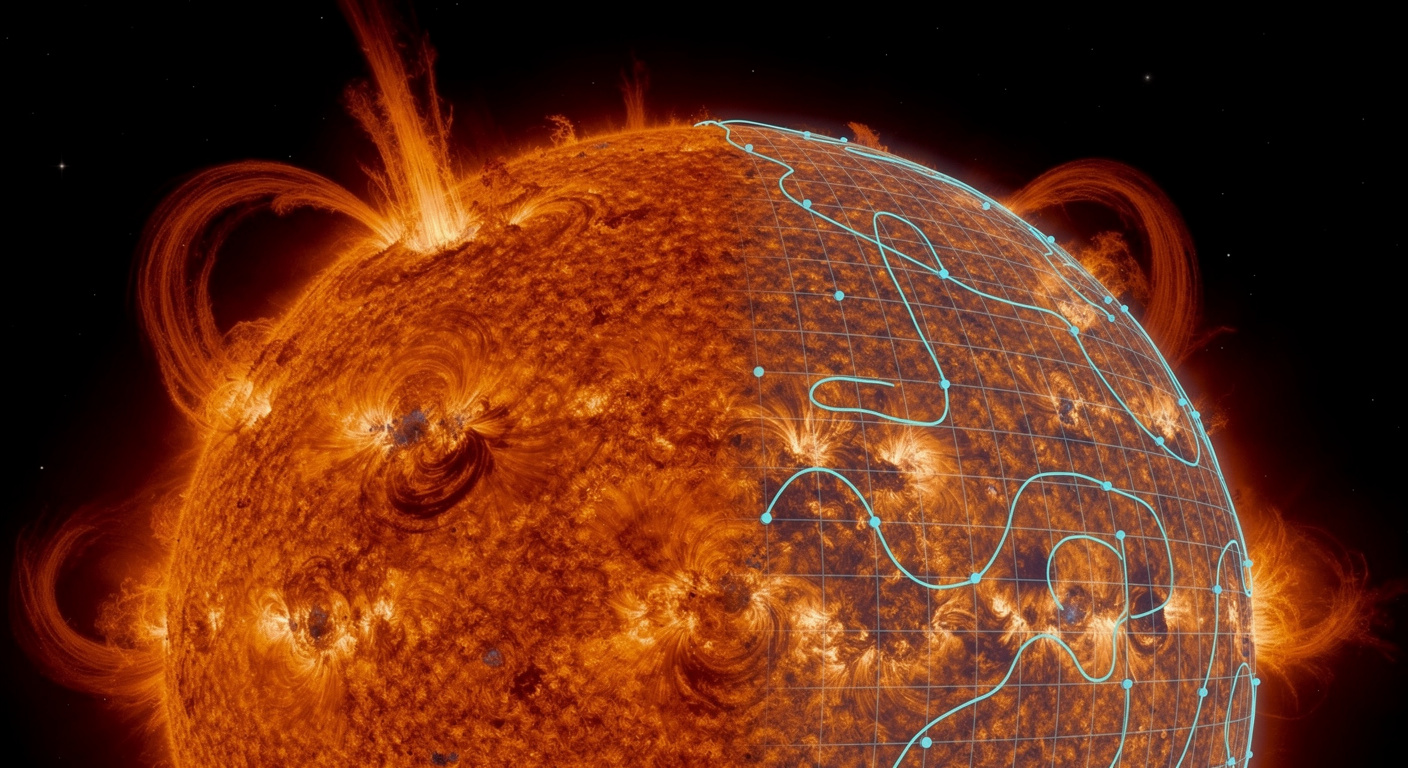
Solar and astronomical influences represent another area where science continues to evolve. The Sun varies in more complex ways than the simplified reconstructions of irradiance used in many models suggest. Several lines of evidence indicate that the climate responds not only to total solar irradiance but also to spectral variations, magnetic modulation, and indirect effects on atmospheric circulation. Although empirical evidence suggests that these mechanisms could play a dominant role—potentially exceeding that of simple total irradiance forcing—their representation in models remains incomplete.
Paradoxically, despite controversies over long-term solar variability, current GCMs are generally forced with solar reconstructions exhibiting extremely low secular variability. This explains why these models attribute nearly 0 °C of post-1850 warming to solar changes and simultaneously fail to reproduce the millennial oscillations visible in paleoclimate records. Furthermore, direct comparisons show that the models do not reproduce the quasi-60-year climate oscillation associated with the warming of the 1940s and tend to overestimate the warming observed since 1980. This “warm model” problem affects a substantial fraction of current GCMs.
All of this points to a key parameter: equilibrium climate sensitivity (ECS). The IPCC’s canonical estimate—approximately 3 °C for a doubling of CO₂, with a likely range of 2.5 to 4.0 °C—stems largely from model-based assessments. However, empirical studies that better account for natural variability often suggest lower values, around 2.2 ± 0.5 °C, or even as low as 1.1 ± 0.4 °C if long-term solar irradiance varies significantly and if other solar mechanisms are involved.
Toward a reevaluation of strategies: adaptation or mitigation?

A comparison presented in the study puts the warming projected by GCMs (assessed by the IPCC) into perspective with projections derived from empirical modeling. While “net-zero” pathways such as the SSP1 scenario are considered necessary to meet the Paris Agreement’s goal (limiting warming to below 2 °C by 2100), empirical considerations suggest that this same goal could be achieved under the much more moderate SSP2 scenario.
This distinction has major global economic implications. Since the dominant narrative of the climate crisis does not appear to be fully supported by the totality of the evidence, adaptation strategies—which are far less costly—could prove more appropriate than highly aggressive mitigation policies. The study emphasizes the importance of addressing these open questions: climate policy must be informed by the full spectrum of scientific evidence, including uncertainties and alternative interpretations.
Source: phys.org
Created by humans, assisted by AI.
Climate: What if current models underestimate natural factors?
This content was created with the help of AI.


