

From palpable tensions to dashed hopes
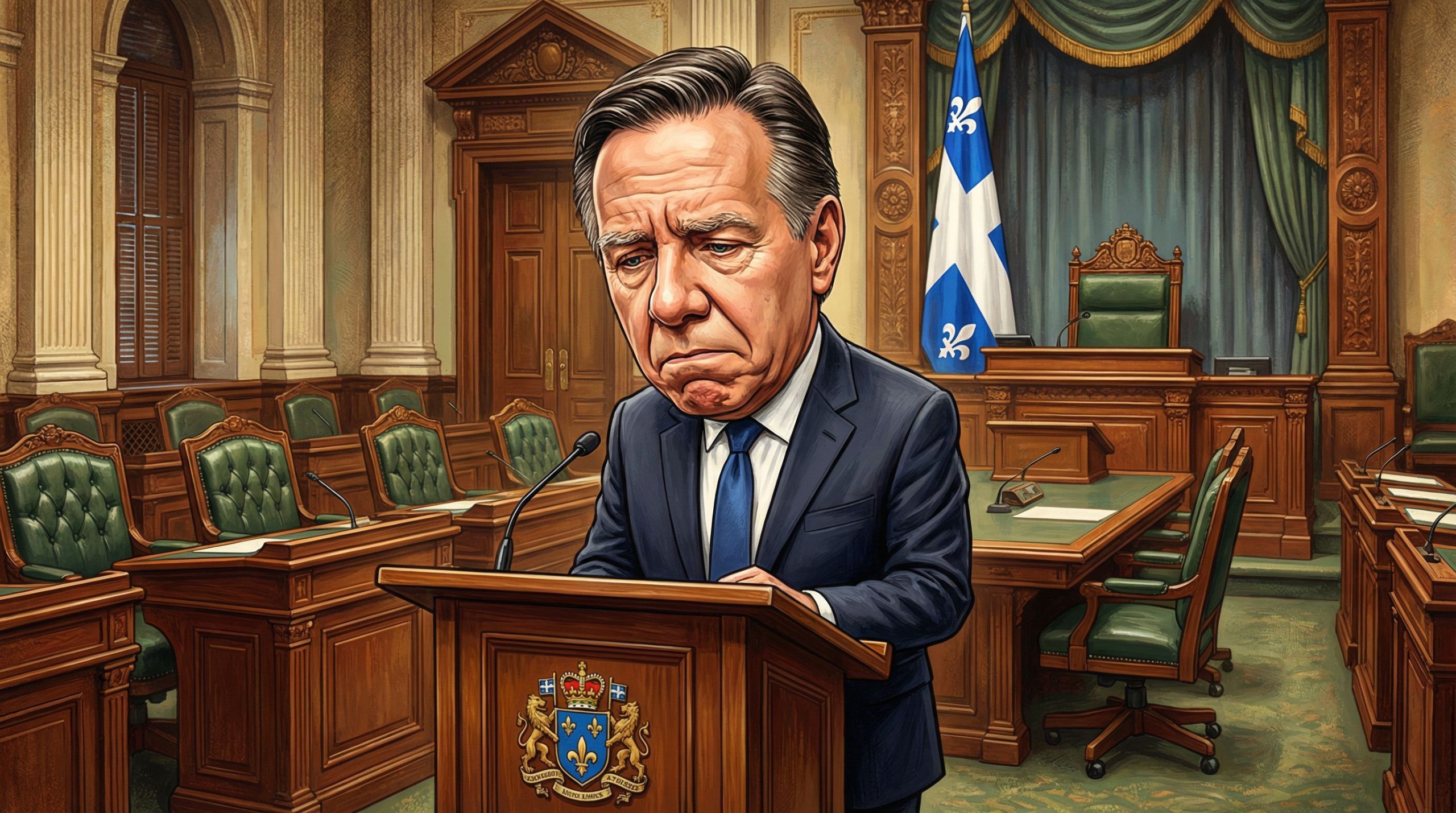
Let’s be honest—the mood was far from festive. If many Indigenous leaders didn’t have François Legault in their hearts, it’s because there’s a history of tension, a heavy burden that has built up over the years. Recently, things have hit a snag on major issues: the infamous Bill 1 on the Quebec Constitution introduced this fall, or the reform of the forestry regime. On those occasions, the chiefs really felt like they were talking to a wall—that the government simply wasn’t listening. It’s a shame, really, because it hasn’t always been that way.
We need to remember the early days… things were off to a pretty good start, weren’t they? Sébastien Brodeur-Girard, a professor at the School of Indigenous Studies at UQAT (Université du Québec en Abitibi-Témiscamingue), refreshes our memory. It was October 2019, right after the Viens report was released. François Legault had made a powerful gesture: an official, solemn apology to First Nations and Inuit for all the harm caused by laws and public services over the years. The National Assembly had even passed a motion recognizing the key principles of the United Nations Declaration on the Rights of Indigenous Peoples (the UNDRIP, as it’s known to insiders). We believed in it.
A six-year standstill

But here’s the thing: after all the fine words, what actually happened? Well… not much, unfortunately. As Mr. Brodeur-Girard so aptly puts it, “that’s where it stopped.” It’s harsh, but that’s the reality. Six years later—yes, six years already—most of the Viens Commission’s calls to action have gone unheeded. I’m not the one saying this; the Ombudsman pointed it out again just recently. And what about the UN Declaration on the Rights of Indigenous Peoples? Same story. The initial opening has snapped shut like an oyster. Why? In the name of the integrity of Quebec’s territory, apparently. The government was absolutely terrified of giving Indigenous peoples a veto over economic projects. So we’ve been treading water, over and over again.
This sense of stagnation is shared by Martin Papillon, a full professor of political science at the University of Montreal. According to him, it never really felt like the relationship with Indigenous peoples was a priority for Mr. Legault. It was always… how should I put it… secondary? It only became an issue when things heated up, when Indigenous peoples mobilized, or when it created political problems. It’s sad to say, but it was crisis management, not relationship-building. Mr. Papillon doesn’t mince words: while elsewhere in Canada—at the federal level or in other provinces—we’re seeing a real shift in legal awareness, Quebec seems to be lagging behind. He even describes the Legault government’s approach as somewhat “outdated.” It’s a strong word, he admits, but he stands by it. An approach that dates back to another era, perhaps.
A fundamental misunderstanding
The root of the problem may lie in the way François Legault perceived his counterparts. Researchers note that he struggled to view First Nations and Inuit as true partners. To him, they were interest groups, citizens of the “great Quebec nation,” but not Nations in their own right. Mr. Papillon points out that even though the term “Nation-to-Nation” was sometimes used in official communications—because it sounds good—in practice, actions didn’t follow through. It was all style, no substance.
And then there is this—almost obsessive—refusal to acknowledge systemic racism. We recall the tragedy of Joyce Echaquan. Ian Lafrenière, the minister responsible, made a low-key appearance at the symposium dedicated to her in Trois-Rivières in October 2025. Despite everything, the government has stubbornly refused to acknowledge the structural nature of the inequalities and discrimination embedded within the Quebec government. It’s as if, according to Martin Papillon, they simply refuse to see the obvious.
Mind you, it’s not all doom and gloom either. Credit where credit is due: there have been successes, such as the passage of Bill 79. This is an important law regarding the disclosure of personal information to the families of Indigenous children who went missing or died after being admitted to an institution. Mr. Brodeur-Girard highlights this, and it’s important.
Conclusion: A missed opportunity?

In the end, what will we take away from this? That the word “reconciliation” wasn’t really part of François Legault’s everyday vocabulary. Sébastien Brodeur-Girard is quite categorical on this point. The premier didn’t implement the Viens Commission’s calls to action; he didn’t incorporate the UN Declaration on the Rights of Indigenous Peoples into law… but the worst part is that he didn’t propose anything else. He could have said, “Listen, we can’t do what the commission is proposing, but here’s our Plan B; here’s what we’re offering in exchange.” But no. There was nothing concrete offered in return. It’s a void, a silence. A missed opportunity to build something solid, I suppose.
Legault and First Nations: Why Did the Dialogue Break Down?
This content was created with the help of AI.


