

When Life Takes Back Its Place Where We Least Expected It
We often have this somewhat simplistic view of our bodies: a well-oiled machine where, when a part breaks, it’s simply thrown away. That’s what we’ve been taught, isn’t it? A damaged cell receives a signal, and just like that, it’s eliminated. It’s clean, neat, and seamless. But now science comes along—as it often does—to shake up our certainties with a discovery that’s quite unsettling, I must say.
It seems that the line between a cell’s end and its renewal isn’t so clear-cut. Researchers have uncovered an unexpected phenomenon: certain cells, though programmed to disappear, put up a fight. And they don’t just survive—no… they set to work repairing the damage. It’s a bit like workers we thought we’d sent home deciding, in the end, to rebuild the house. This mechanism, which was still poorly understood until recently, could very well revolutionize the way we treat damaged tissue—and even help us better understand that pesky disease known as cancer.
The Mystery of DARE Cells: Survivors Dedicated to Repair
It all began at the Weizmann Institute of Science in Israel. There, a team of researchers decided to observe what happens when a living organism is subjected to stress—in this case, fruit fly larvae, you know, those little vinegar flies we often see in the summer. They irradiated these larvae to see how they would recover. As expected, certain biological processes activated a very specific enzyme: caspase. To put it simply, this is the usual trigger for internal cellular suicide. Once activated, the cell is supposed to die.
But, surprise… some of these cells survived. They refused to die. Worse—or better, depending on your point of view—they entered a cycle of rapid proliferation. The scientists, likely astonished by what they were seeing, dubbed these resilient cells DARE, an acronym for Dronc-Activating Regenerating Cells. And the best part is that they don’t work alone. According to an article reported by ScienceAlert, these DARE cells recruit neighboring cells, called NARE, which had not received any death signals. Together, they form a sort of strike team to coordinate the repair of the damaged area.
The result is quite impressive. The repaired area doesn’t simply return to normal; it becomes stronger. After a second round of radiation, the descendants of these DARE cells were significantly more resilient. The numbers speak for themselves: they proved seven times harder to destroy than the original cells. It’s fascinating, but it also sends a slight chill down my spine, because this “super-resistance” behavior is strikingly similar to that of certain tumors that recur after treatment. There’s a clear link here between regeneration and increased survival that we’ll need to monitor closely.
At the Heart of DNA: When Genetic Manipulation Comes into Play
Of course, cell survival is only part of the equation. For everything to work, the internal machinery must also function properly—and that involves controlling DNA with precision. Regeneration relies on a vital ability of the body: repairing DNA in a targeted manner without causing chaos, a process known as homologous recombination. This is essential for preventing mutations.
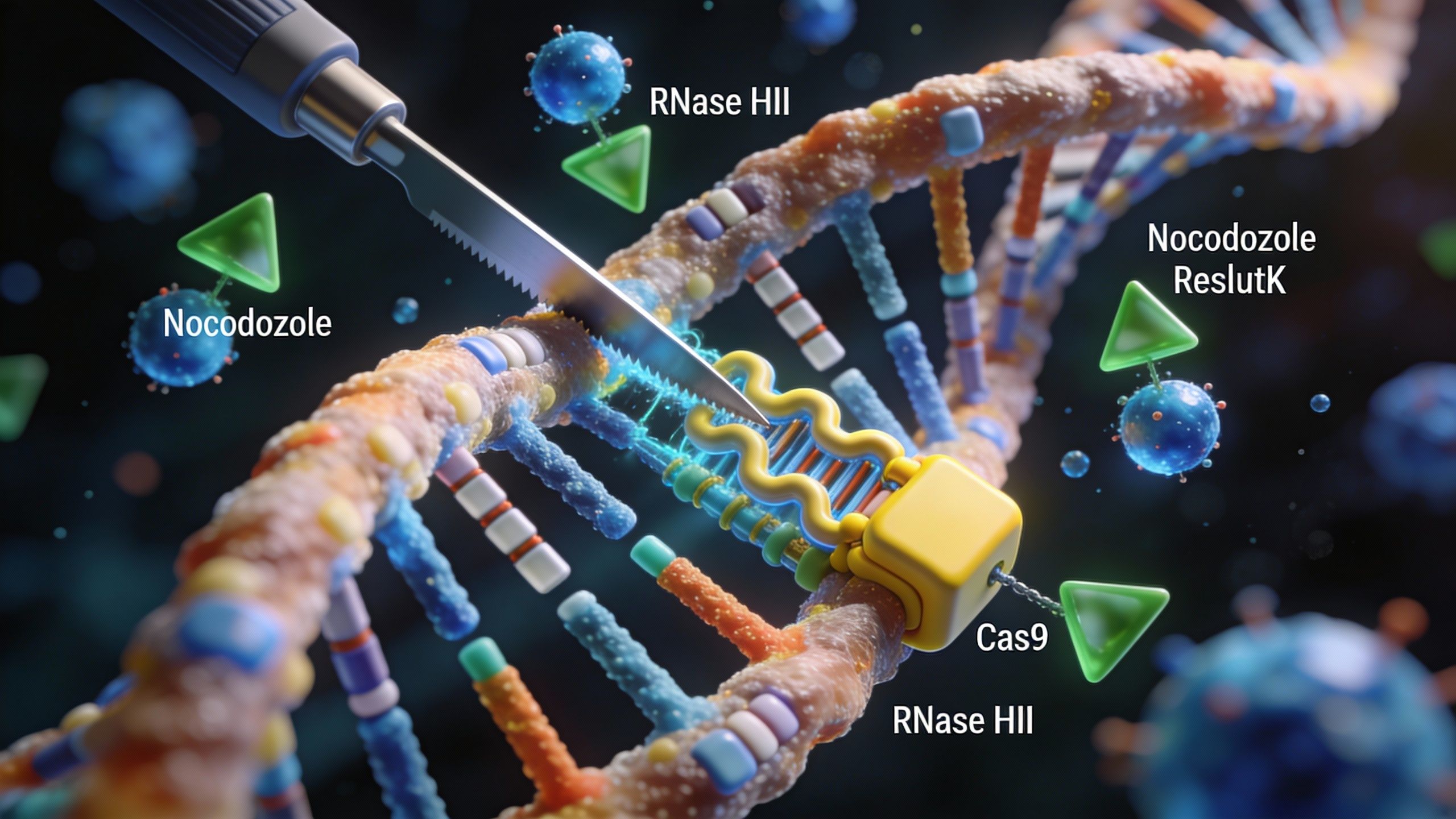
Another study, this time published in Scientific Reports, set out to explore this topic further. The researchers brought out the big guns with CRISPR/Cas9, that revolutionary tool—a sort of molecular pair of scissors—that allows the genome to be modified. Their goal? To insert long DNA fragments into mouse cells. But let’s be honest, this kind of intervention remains a challenge: the success rate is often low and depends on too many unpredictable internal factors.
- Nocodazole, which blocks cell division at a very specific moment.
- RNase HII, another substance that helps correct minor errors during DNA replication.
Conclusion: Immense hope, but caution is needed
So, what should we make of all this? Now that we’re beginning to better understand it, this cellular regeneration seems like a double-edged sword. On the one hand, DARE cells are heroes: they survive the impossible to rebuild our tissues. On the other hand, their stubborn refusal to die and their heightened resistance are strangely reminiscent of the mechanisms of cancer. Stimulating these cells could help us heal faster after an injury—that’s true. But conversely, we might need to block their activation to prevent a tumor from recurring after radiation therapy.
We’re not quite there yet, but this research opens up incredible possibilities. Whether for gene therapy or regenerative medicine, understanding how certain cells decide to “come back to life” is a game-changer. Regeneration is no longer just a passive biological process; it could become a true therapeutic tool. We’ll just need to learn how to fine-tune it.
Why do cells that are supposed to die suddenly decide to save us?
This content was created with the help of AI.


