

The Strategy of Slowness: A Bold, Evolving Choice

To unravel the mystery of this extraordinary lethargy, a team of scientists delved into the depths of its genome. According to a study published in the journal BMC Biology, the secret to this slow-paced existence lies in what researchers call “jumping genes.” These mobile genetic elements are believed to have played a crucial role in shaping the animal’s biology.
Genetic Analysis at the Heart of European Laboratories
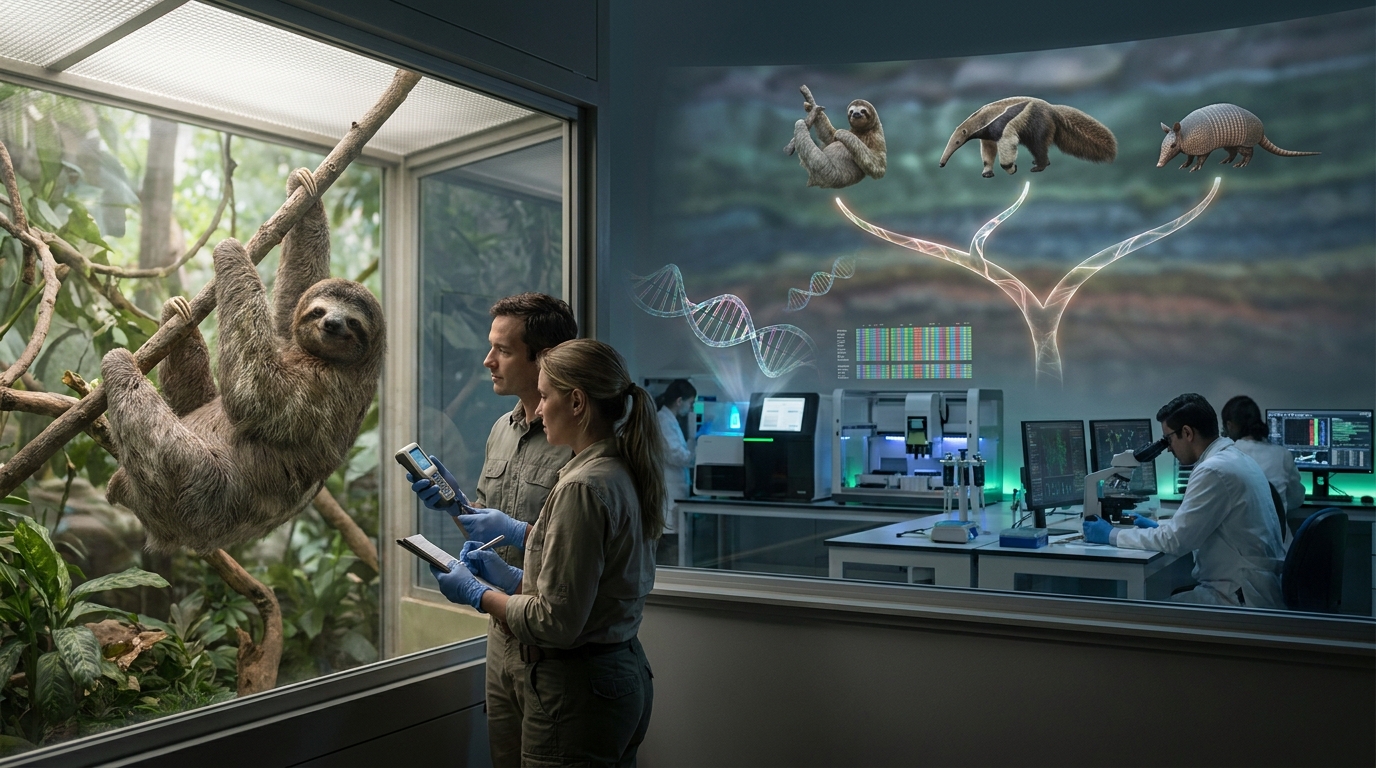
To carry out this biological study, DNA was extracted from the tissues of a captive sloth residing at Tierpark Berlin. Sequencing was then performed in Germany at the Max Planck Institute for Molecular Cell Biology and Genetics. This crucial technical step made it possible to obtain a precise map of the animal’s genetic identity.
These three animals belong to the Xenarthra clade. This name, derived from the Greek “xénos,” meaning “strange” or “foreign,” is a designation dating back to the 19th century. Although this term may seem outdated today, it perfectly highlights just how distinct these South American mammals are from the majority of other species inhabiting our planet.
The Impact of Transposable Elements on Metabolism
Genetic analysis has revealed that sloths may be the most unique of all Xenarthra. Their genome contains multiple active copies of transposable elements, also known as transposons or “jumping genes.” These are mobile genetic elements capable of “copying and pasting” themselves into different locations within an individual’s genome.
Many of these functions are related to energy management and metabolism. Some of these genes are directly linked to mitochondria, often described as the “powerhouses of the cell.” By fine-tuning how cells produce and manage energy, these mobile genetic elements support the sloth’s wonderfully lethargic lifestyle.
A 30-million-year-old biological legacy

Researchers have determined that these jumping genes first appeared about 30 million years ago in the common ancestor of all modern sloth species. Because they promoted the species’ continued survival, these elements have been preserved over the ages to the present day, shaping the species as we know it.
"Evolution has already conducted billions of experiments. By studying unusual animals like sloths, we sometimes discover biological solutions that humans have never developed," said Dr. Marcela Uliano-Silva, a senior bioinformatician and co-lead author at the Wellcome Sanger Institute, in a press release.
She added: “By using genomics to look back in time, we found ‘jumping genes’ that sloths have retained for millions of years. These sloth-specific genes are linked to mitochondria and metabolic pathways, suggesting they may be related to the evolution of their extremely slow metabolism.”
From Sloths to Human Medicine and Space Travel
As is often the case with this type of scientific research, the researchers believe their study has much broader implications, particularly in the field of human health. By taking note of the sloth’s unique genetic characteristics, we could gain valuable insights for the development of new treatments for certain diseases.
Dr. Pedro Galante, co-lead author at the Sírio Libanês Hospital in São Paulo, explains: “Many human conditions—including diabetes, age-related disorders, neurodegeneration, and muscle atrophy—involve problems with energy production and mitochondrial function. Although further research is needed, sloth cell lines could provide a natural model for understanding how organisms cope with low-energy states—and what goes wrong in the event of disease.”
In the long term, these findings could inform research on tissue preservation, critical care medicine, aging, metabolic diseases, and even long-duration space travel, where managing the body’s energy is a major challenge. For any medical questions, consult a qualified healthcare professional.
Source: iflscience.com
Why is the sloth so slow? Jumping genes explain its incredible metabolism


