

A Half-Century-Old Cosmological Mystery Finally Solved
Mark Gorski, an assistant research professor at Northwestern University’s Center for Interdisciplinary Exploration and Research in Astrophysics (CIERA) and co-lead author of the study, explains the fundamental logic behind this discovery: “Unless a black hole exists in a perfect vacuum, it must somehow blow a wind,” he says. “And there is no perfect vacuum in the universe. With new observations, this is the first time we’ve had a clear enough view to see the wind’s signature. We looked at the data and said, ‘There it is. This is the thing everyone has been looking for for 50 years.’”
The obstacle of the galactic plane and the observational power of the ALMA network
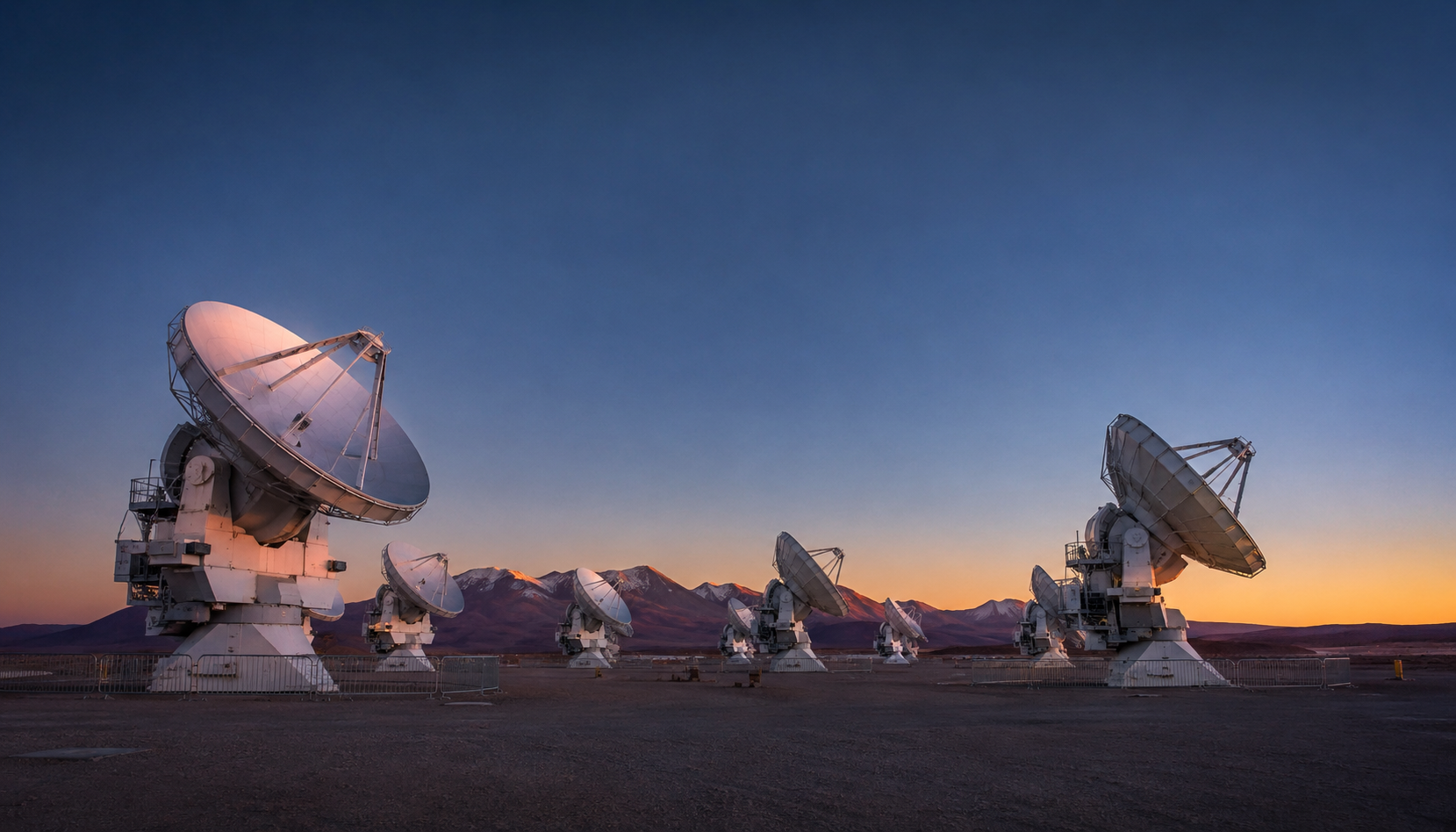
Elena Murchikova, co-lead author of the study, assistant professor of physics and astronomy at Northwestern’s Weinberg College of Arts and Sciences and a member of CIERA, highlights this observational challenge: “To observe our own black hole, we have to look through the plane of our galaxy,” she explains. “That means we have to peer through gas, dust, and ionized structures, and you can’t really see through all of that easily.”
The Unexpected Appearance of a Giant Cone-Shaped Cavity
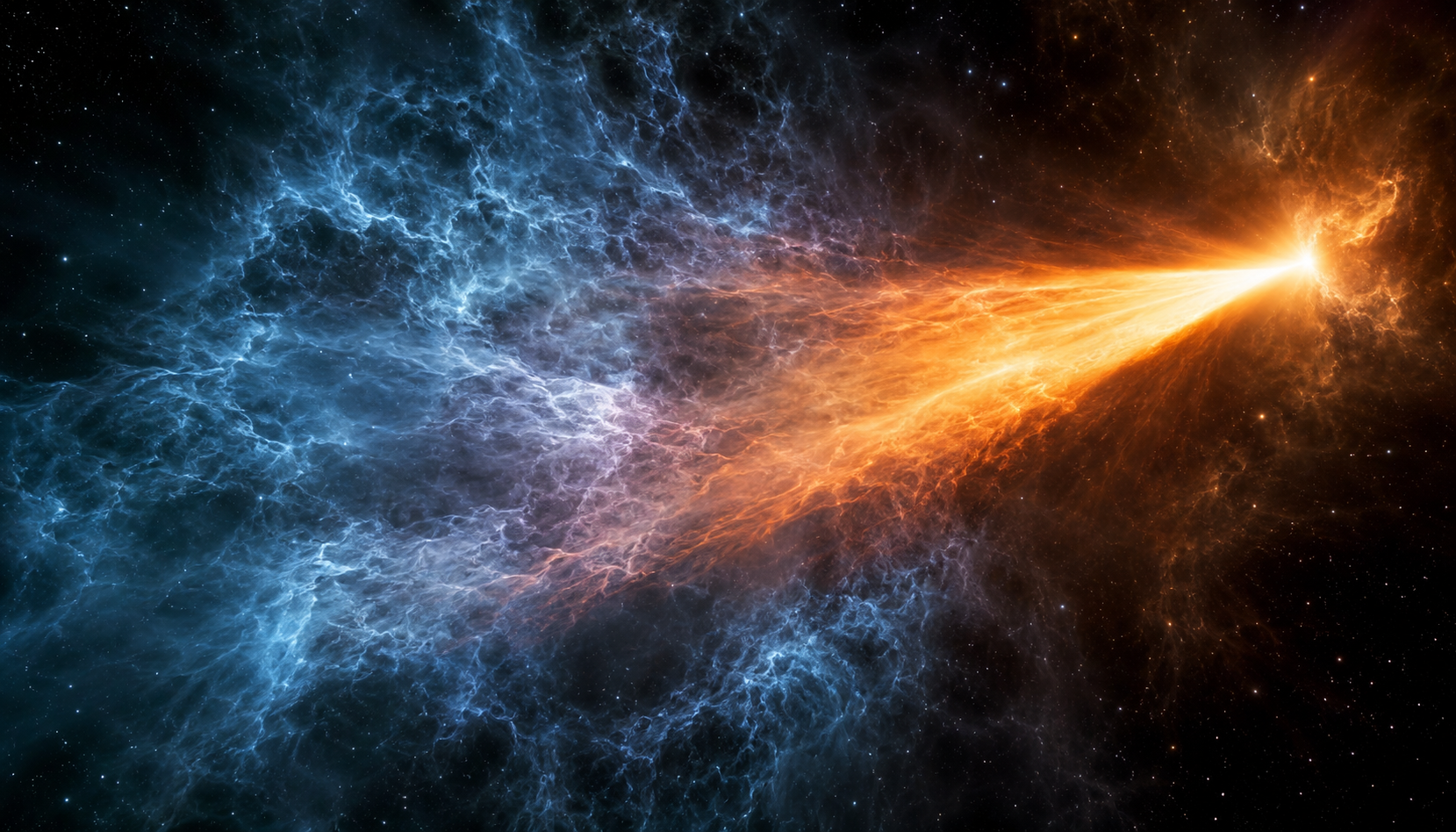
This hollowed-out region extends over a length of nearly one parsec and flares out to a width of 45 degrees, taking on the distinct shape of a cone. According to the study’s authors, this localized absence of cold gas can only be the physical imprint left by the hot, energetic wind expelled by Sgr A*, which sweeps through or heats the surrounding environment as it passes.
Mark Gorski explains the thermal dynamics at work in this cosmic region: “If you blow hot material out from the black hole, it won’t want to coexist with the cold material,” he says. “It will either push the cold material away or heat it up. And if it’s too hot, you won’t see the cold gas anymore.”
Energy calculations cross-referenced with Chandra X-ray data

“It’s a massive void of matter,” explains Mark Gorski regarding the observed cavity. “We calculated the amount of energy needed to create this cavity. It’s more than what the stars in this region can provide. Basically, there must be an energy input from the supermassive black hole. And if you follow the shape of the cone, it points directly toward the black hole.”
To confirm the accuracy of these results, the team cross-checked its data with previous observations from NASA’s Chandra X-ray Observatory. Chandra had detected intense X-ray emissions in exactly the same conical region. “Extraordinary claims require extraordinary evidence,” Mark Gorski points out. “We wanted to make sure we weren’t just looking at some kind of imaging artifact. Then, Chandra’s X-ray image fit perfectly. The molecular features aligned.” Elena Murchikova shares this sense of relief: “When you find something no one has seen before, the first thought that crosses your mind isn’t ‘Oh my God, we’ve made a discovery,’” she says. “It’s ‘Oh my God, what’s wrong with my analysis?’ But when we superimposed our image onto the X-ray image, it started to make sense.”
A unique window into the dominant, calm state of black holes
Beyond the visual confirmation of the galactic wind, this discovery—published in 2026 in The Astrophysical Journal Letters and available on arXiv—offers new insights into the overall evolution of galaxies. Astrophysicists estimate that this specific wind has been active for at least 20,000 years, a timeframe deduced from the extent of its effects on a nearby stream of ionized gas.
The observations definitively confirm the accretion mechanism at work in the center of the Milky Way, while also confirming the quiet nature of Sagittarius A* compared to other black holes. “We were the first to show that molecular gas very, very close to the black hole feeds it,” notes Elena Murchikova. “The wind isn’t powerful, and its direction likely wanders over time. This shows that our black hole is not unique, and that our place in the universe is not unique.”
This scientific breakthrough allows us to study the norm—rather than the exception—of the life cycle of these colossal entities. “Most other galaxies spend the majority of their lives in a state where they are not particularly active,” concludes Elena Murchikova. "But we can only see them when they’re in a ‘fireworks’ phase. It’s very appealing to study black holes when they’re in the ‘fireworks’ phase, but that’s not really their dominant state. Sgr A* finally gives us a window into the life of a black hole in this quiet state."
Source: phys.org
Wind from the Milky Way’s supermassive black hole detected after 50 years of research


